Skip to content

Index

Why RPN Needs an Ecosystem, Not Another Retro Replica

RPN calculators already exist. StackCalc is not a nostalgia project trying to recreate a familiar beige machine. The gap we see is a learning path: a way to move from a familiar screen to a physical instrument while understanding what the stack is doing.

That is why StackCalc joins the current iPhone and Apple Watch apps, a shared calculator core, Learning Lab prototypes, and an RP2350 handheld whose board is in fabrication around the same calculation behavior. The connection is semantic, not cosmetic.
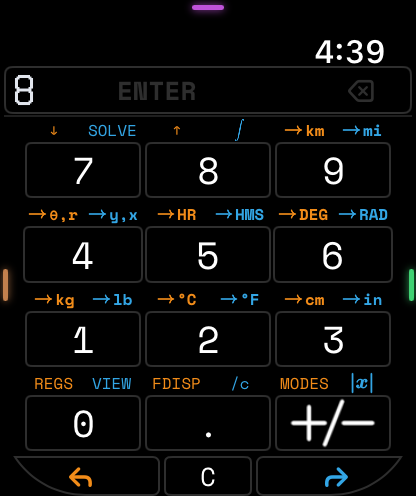
Why We Started with the Apple Watch

For many children, the first personal computer they wear is not a phone or laptop. It is a watch, often after an iPad. That changed where we started StackCalc. The Apple Watch was not a companion screen added after the calculator had been designed; it was the first place we had to prove that an RPN calculator could explain its next action in a very small space.

StackCalc on Apple Watch, where the stack and the next action have to stay legible at a glance.

What the Firmware Simulator Can Tell Us Before Board Bring-Up

The current StackCalc prototype is a 3D-printed, tool-free mechanical assembly. Its RP2350 calculator PCB design is in fabrication, but no board has yet been assembled and powered, so we cannot yet make claims about powered bring-up, battery life, display behavior, or key feel on the finished electronics.

That is why the firmware simulator is useful. It gives us a fast way to exercise the calculator software and its proposed row-and-column interface while the physical electronics are still being developed. It is evidence about the simulated build, not evidence that a physical PCB works.