Shipping StackCalc v1.1 on the App Store: A Clean-Room RPN Calculator That Grows With Your Kid (SC-6 to SC-32)
When I trained my own kids to use Reverse Polish Notation (RPN) on a SwissMicros DM41CC, three things became immediately obvious:
1. Kids do not struggle with RPN—they struggle with infix parentheses. Pushing two numbers onto a visible stack and combining them matches the exact order in which children push physical blocks together on a desk. Even better, because there is no hidden infix parser behind an = key, users learn operator-precedence parsing in their own minds in order to decompose and enter expressions onto the stack—appreciating the lessons learned in the past 50 years of computing so they can build the next 50 years.
2. Handing a student a CAS calculator is a trap for exams. Because Computer Algebra System (CAS) calculators are banned on the SAT, ACT, IB, UIL, NCEES FE/PE engineering exams, and university calculus midterms, we purposefully designed StackCalc to be allowed in testing situations (no CAS symbolic manipulation, no QWERTY keyboard, and no wireless transceivers on the hardware).
3. Sending a kid to school with a $250 collector's calculator or a $200 vintage eBay HP-32SII is a terrible idea.
That realization sparked the overarching vision for StackCalc: building a low-cost, kid-friendly RPN calculator and tactile learning ecosystem that grows with a student from first grade through university engineering—starting with our small-batch maker hardware at $89.99 while engineering our production roadmap toward a $29.99 student backpack target.
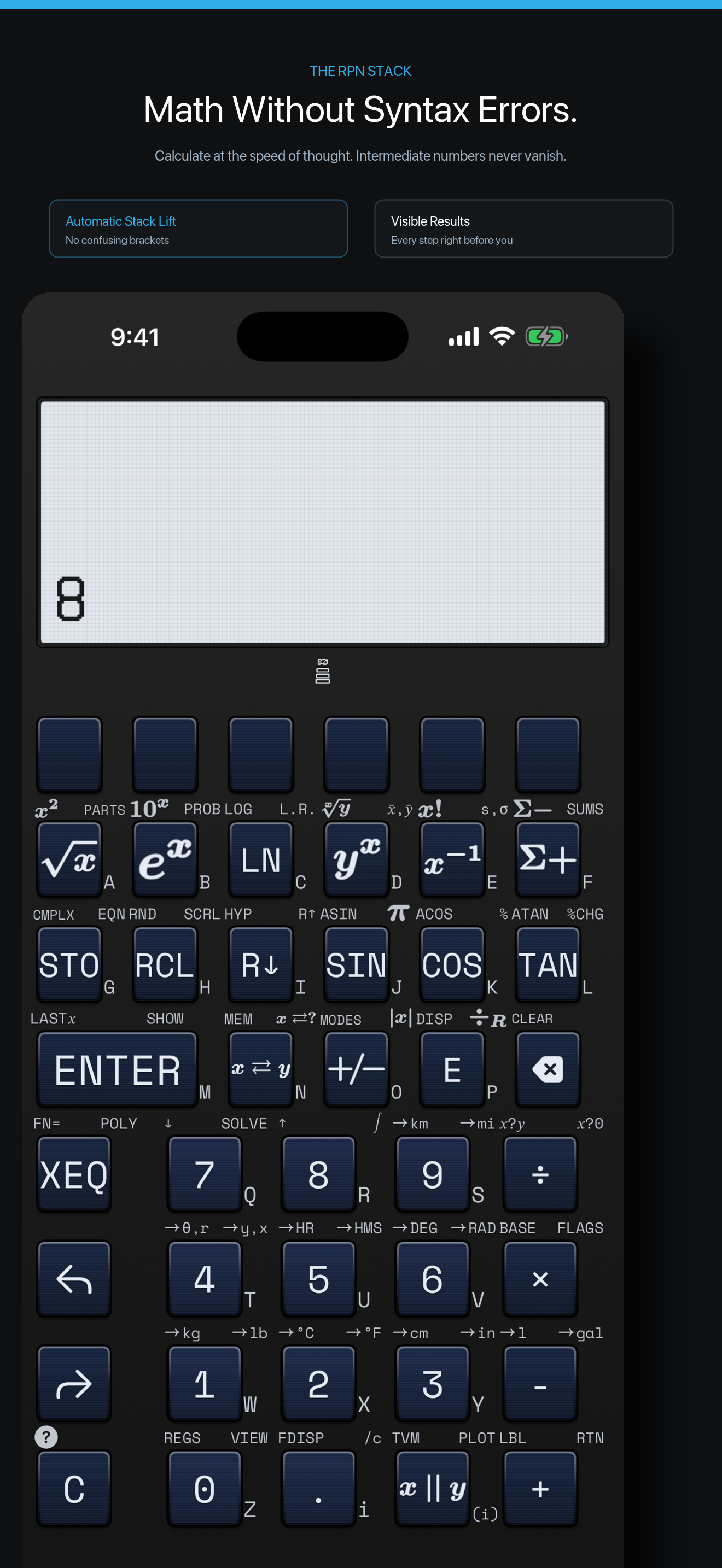
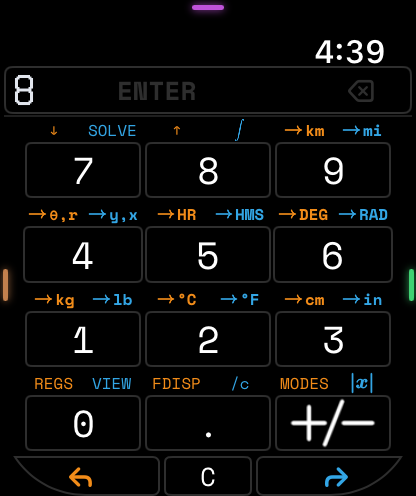
Today, StackCalc Calculator v1.1 is live on the Apple App Store for iPhone, iPad, and as a 100% standalone Apple Watch app, uniting Visual Learning Mode (StackCalc 6) for Common Core K–6 math with Scientific Mode (StackCalc 32) inside one universal binary.