Skip to content

RPN

One Calculator Core for Watch, Phone, and RP2350

A calculator can look consistent across devices while disagreeing at exactly the moments that teach people how RPN works: ENTER, stack lift, an error state, a program step, or an unfinished number. We did not want the Watch, iPhone, and eventual handheld to agree only on the happy path. StackCalc has one calculator core so a named key sequence has one meaning before any surface decides how to draw it.

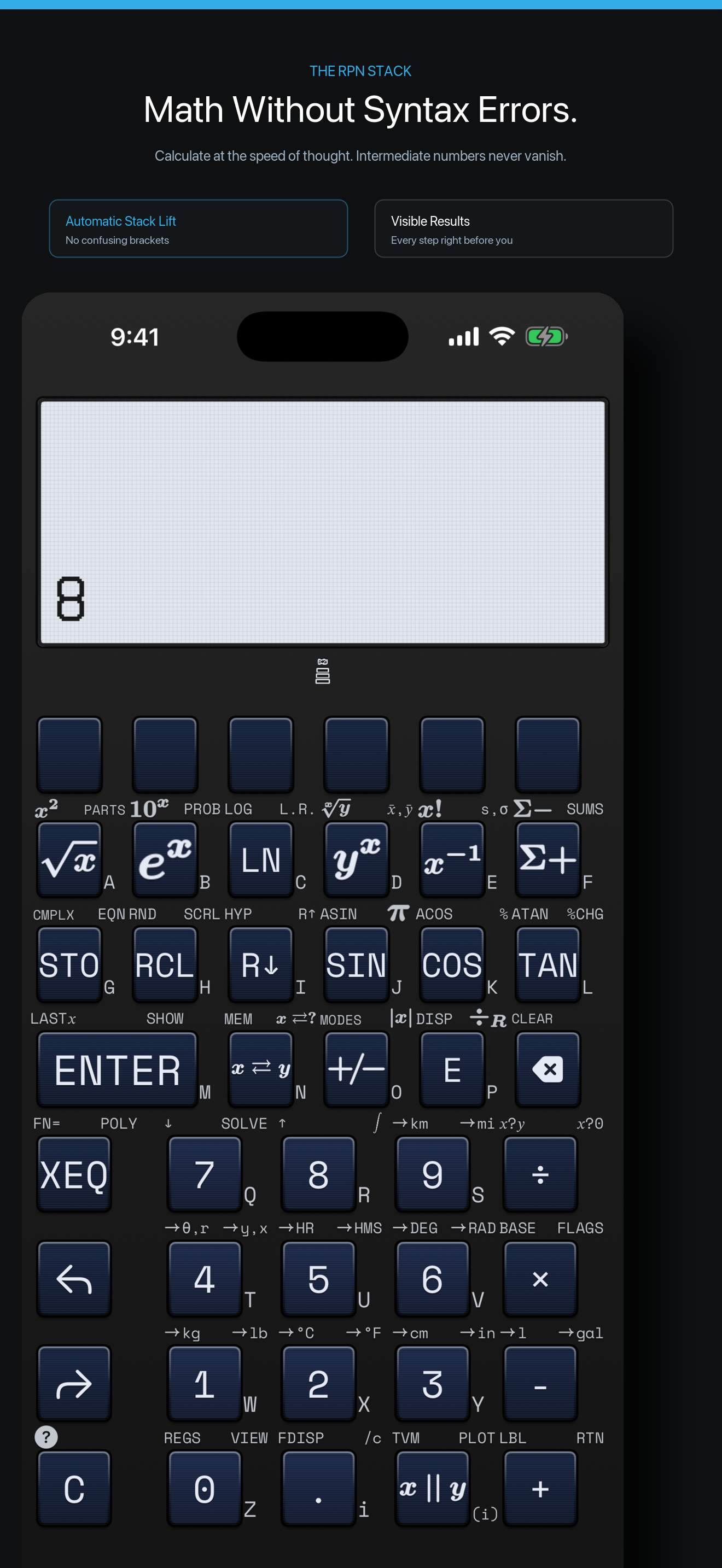
The iPhone app exposes the same RPN stack that the firmware-facing path renders into a compact display.

Teaching Fractions as an RPN Sequence

Fractions create two useful RPN questions: what quantity does a numerator and denominator represent, and what sequence turns those quantities into a result? The Learning Lab fraction studio keeps those questions side by side instead of asking a learner to jump straight to a symbolic entry.

Why RPN Needs an Ecosystem, Not Another Retro Replica

RPN calculators already exist. StackCalc is not a nostalgia project trying to recreate a familiar beige machine. The gap we see is a learning path: a way to move from a familiar screen to a physical instrument while understanding what the stack is doing.

That is why StackCalc joins the current iPhone and Apple Watch apps, a shared calculator core, Learning Lab prototypes, and an RP2350 handheld whose board is in fabrication around the same calculation behavior. The connection is semantic, not cosmetic.

Why We Started with the Apple Watch

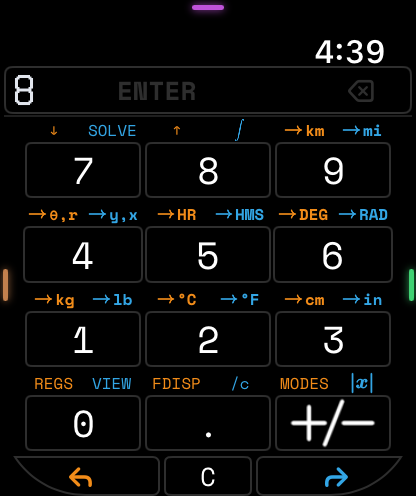
For many children, the first personal computer they wear is not a phone or laptop. It is a watch, often after an iPad. That changed where we started StackCalc. The Apple Watch was not a companion screen added after the calculator had been designed; it was the first place we had to prove that an RPN calculator could explain its next action in a very small space.

StackCalc on Apple Watch, where the stack and the next action have to stay legible at a glance.