Skip to content

Education

From OpenSCAD to the Classroom Desk: 84mm Fraction Towers, Logarithmic Prime Blocks, and Unit-Tested Books

Whenever we tell someone we are manufacturing a new calculator alongside 3D-printed math blocks and printed textbooks, the natural question is: "In a world with smartphones and AI, why does the world need another calculator?"

Because even in the age of AI, students still need to know how to think mathematically. Handing a child an AI chatbot—or a standard school calculator where they type nested parentheses (12 + 8) / (5 - 1) = into a black box—hides every intermediate step of reasoning. By contrast, on a stack-based RPN calculator, students learn operator-precedence parsing themselves because they must break expressions down in the right order of operations to enter them onto the stack, seeing every intermediate result step by step. And unlike CAS (Computer Algebra System) calculators—which are banned on the SAT, ACT, IB, UIL, and college math exams—our calculator is purposefully designed to be allowed in testing situations (zero CAS symbolic manipulation, zero QWERTY keyboard, and zero wireless radios on the hardware).

Our goal with the StackCalc Ecosystem is to make every step of mathematical reasoning visible and physical, connecting 3D-printed classroom manipulatives (manufactured in-house and on Slant3D), unit-test-verified reference books, and our SC-6 / SC-32 calculators.
Shipping StackCalc v1.1 on the App Store: A Clean-Room RPN Calculator That Grows With Your Kid (SC-6 to SC-32)

When I trained my own kids to use Reverse Polish Notation (RPN) on a SwissMicros DM41CC, three things became immediately obvious: 1. Kids do not struggle with RPN—they struggle with infix parentheses. Pushing two numbers onto a visible stack and combining them matches the exact order in which children push physical blocks together on a desk. Even better, because there is no hidden infix parser behind an = key, users learn operator-precedence parsing in their own minds in order to decompose and enter expressions onto the stack—appreciating the lessons learned in the past 50 years of computing so they can build the next 50 years. 2. Handing a student a CAS calculator is a trap for exams. Because Computer Algebra System (CAS) calculators are banned on the SAT, ACT, IB, UIL, NCEES FE/PE engineering exams, and university calculus midterms, we purposefully designed StackCalc to be allowed in testing situations (no CAS symbolic manipulation, no QWERTY keyboard, and no wireless transceivers on the hardware). 3. Sending a kid to school with a $250 collector's calculator or a $200 vintage eBay HP-32SII is a terrible idea.

That realization sparked the overarching vision for StackCalc: building a low-cost, kid-friendly RPN calculator and tactile learning ecosystem that grows with a student from first grade through university engineering—starting with our small-batch maker hardware at $89.99 while engineering our production roadmap toward a $29.99 student backpack target.

Today, StackCalc Calculator v1.1 is live on the Apple App Store for iPhone, iPad, and as a 100% standalone Apple Watch app, uniting Visual Learning Mode (StackCalc 6) for Common Core K–6 math with Scientific Mode (StackCalc 32) inside one universal binary.

Teaching Fractions as an RPN Sequence

Fractions create two useful RPN questions: what quantity does a numerator and denominator represent, and what sequence turns those quantities into a result? The Learning Lab fraction studio keeps those questions side by side instead of asking a learner to jump straight to a symbolic entry.

Why RPN Needs an Ecosystem, Not Another Retro Replica

RPN calculators already exist. StackCalc is not a nostalgia project trying to recreate a familiar beige machine. The gap we see is a learning path: a way to move from a familiar screen to a physical instrument while understanding what the stack is doing.

That is why StackCalc joins the current iPhone and Apple Watch apps, a shared calculator core, Learning Lab prototypes, and an RP2350 handheld whose board is in fabrication around the same calculation behavior. The connection is semantic, not cosmetic.

Why We Started with the Apple Watch

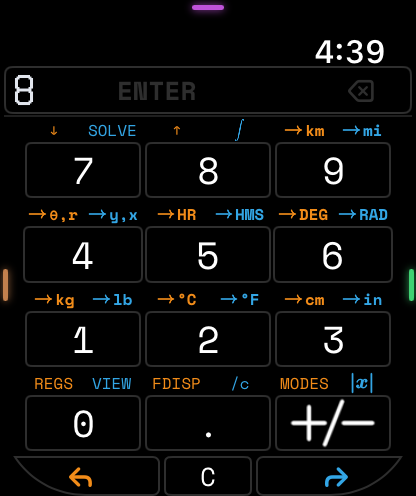
For many children, the first personal computer they wear is not a phone or laptop. It is a watch, often after an iPad. That changed where we started StackCalc. The Apple Watch was not a companion screen added after the calculator had been designed; it was the first place we had to prove that an RPN calculator could explain its next action in a very small space.

StackCalc on Apple Watch, where the stack and the next action have to stay legible at a glance.