
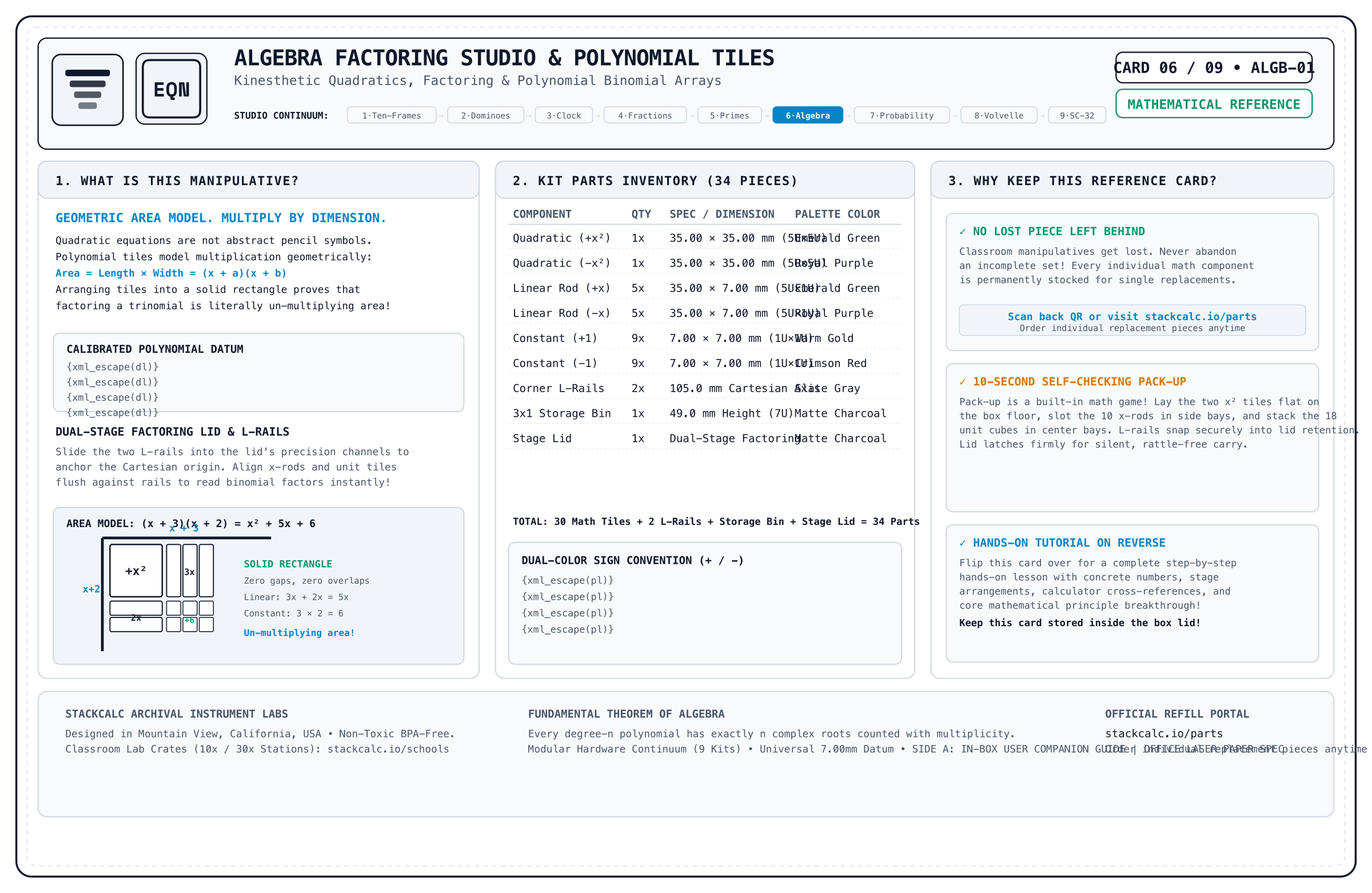
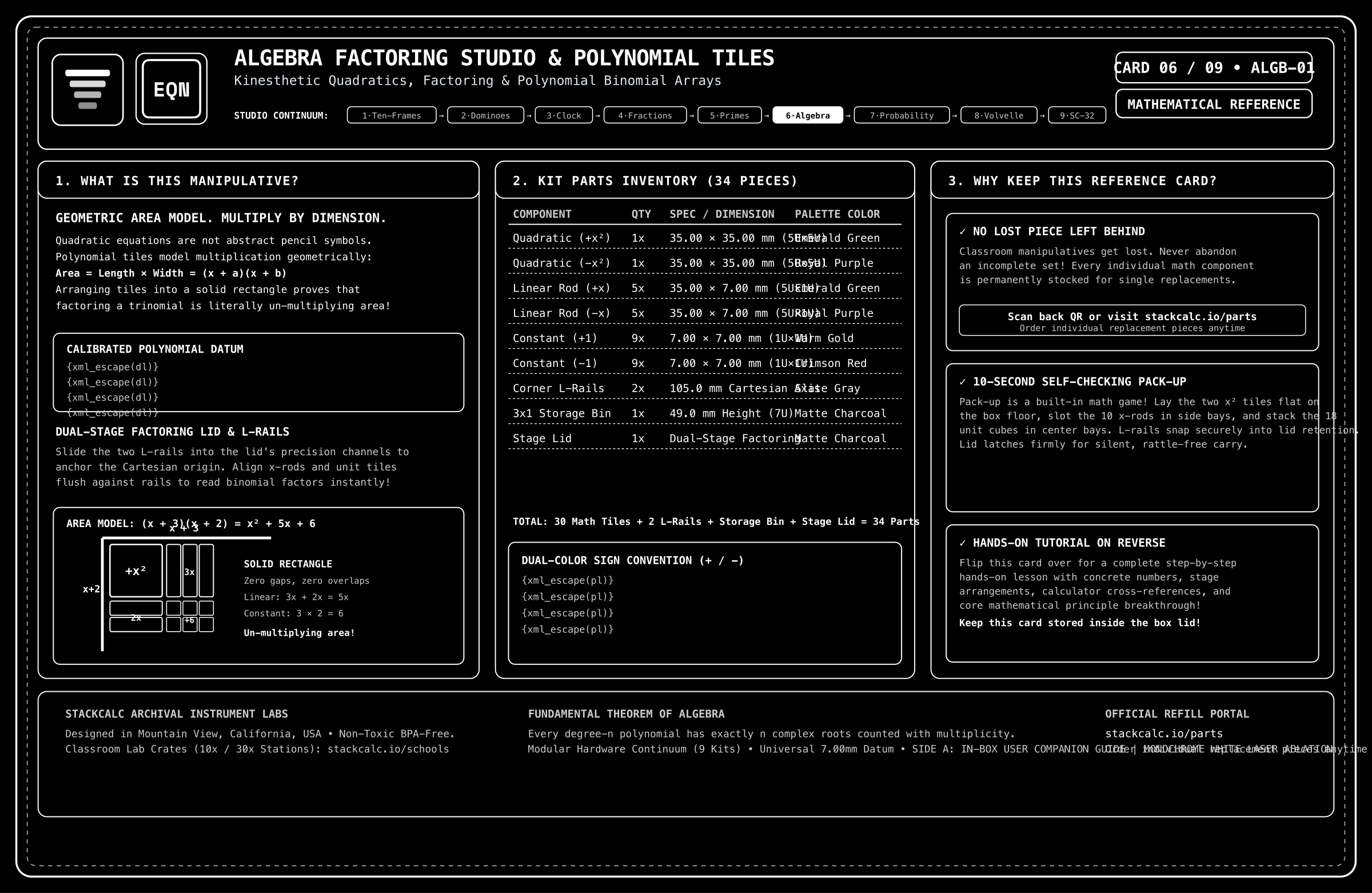

Algebra Factoring Studio & Tiles
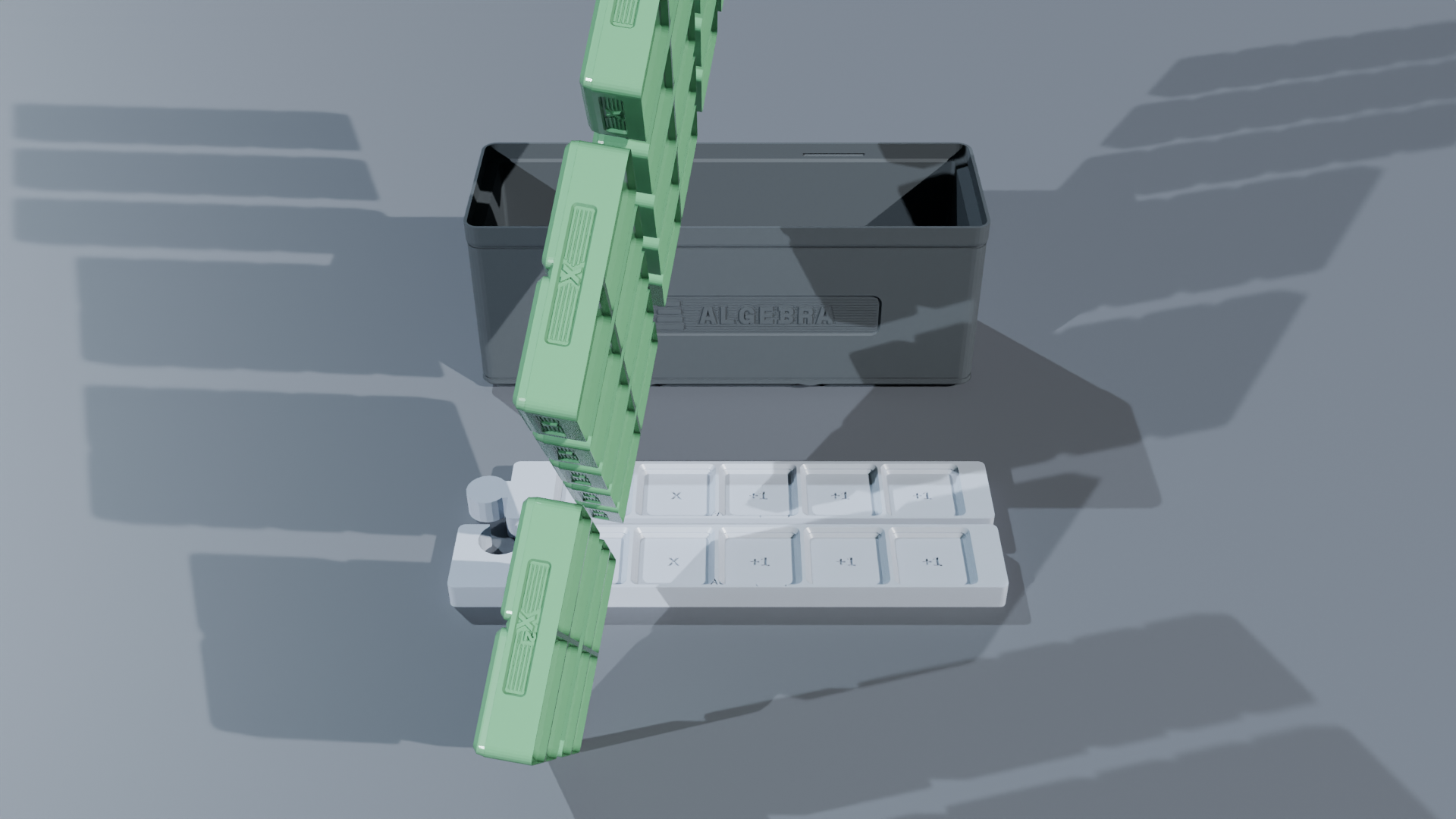
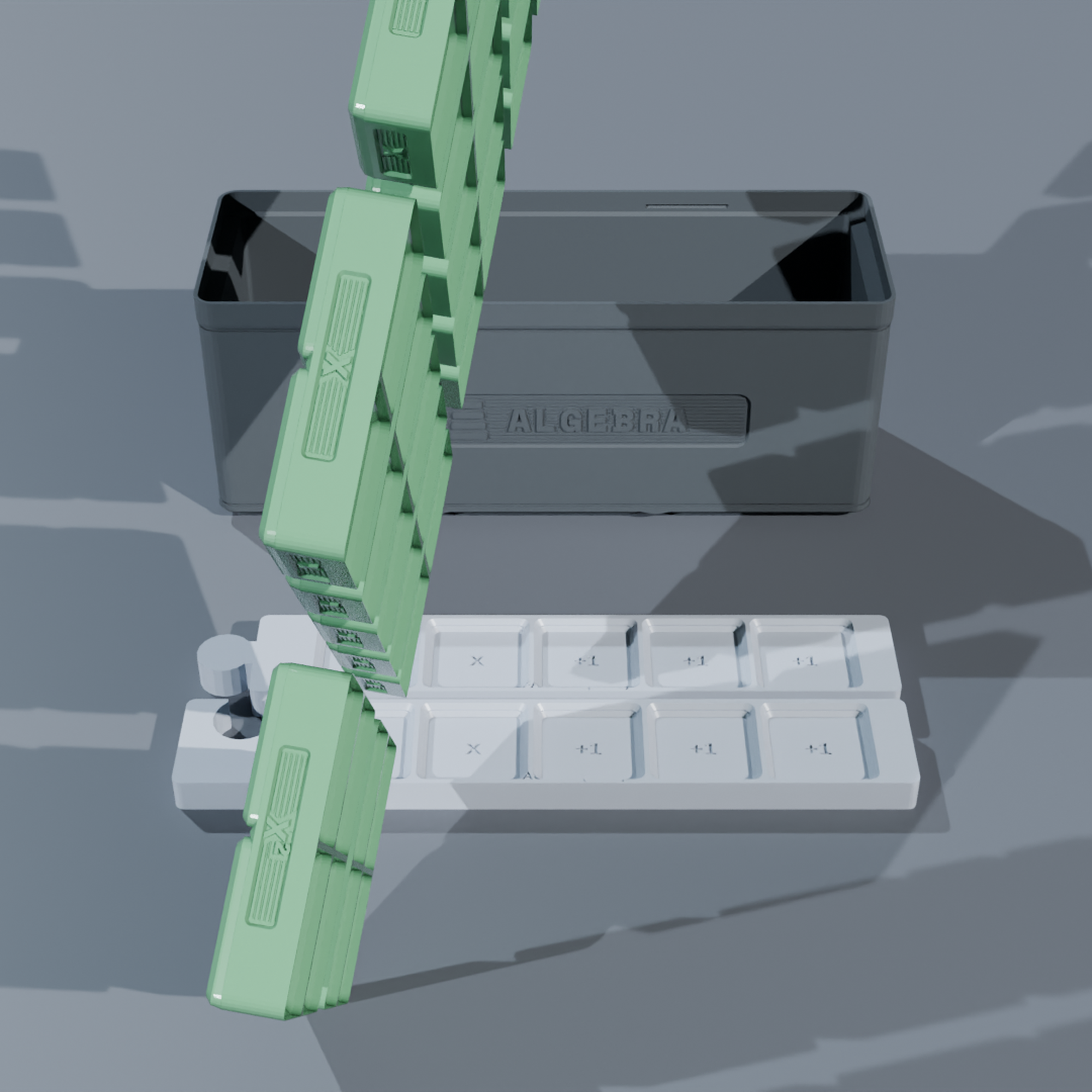
The tactile algebraic laboratory for mastering polynomial expressions, the distributive property, binomial multiplication, and quadratic factoring. A modular 3×1 Gridfinity storage box integrates a precision factoring stage with perimeter guidance rails and 35 chamfered dual-color snap tiles.
Demystifying Factoring with the Area Model
Factoring quadratic trinomials is one of the highest hurdles in early high school mathematics. Algebra Boxes turns abstract equations into intuitive spatial puzzles.
1. Factors as Side Dimensions
When multiplying \((x + 2)(x + 3)\), students arrange an \(x\) bar and 2 units along the vertical rail, and an \(x\) bar and 3 units along the horizontal rail.
2. Product as Enclosed Area
Filling in the interior grid requires exactly one large \(x^2\) tile, five \(x\) bars, and six unit \(1\) tiles. The equation \(x^2 + 5x + 6\) is immediately visualized as a complete rectangle.
3. Completing the Square
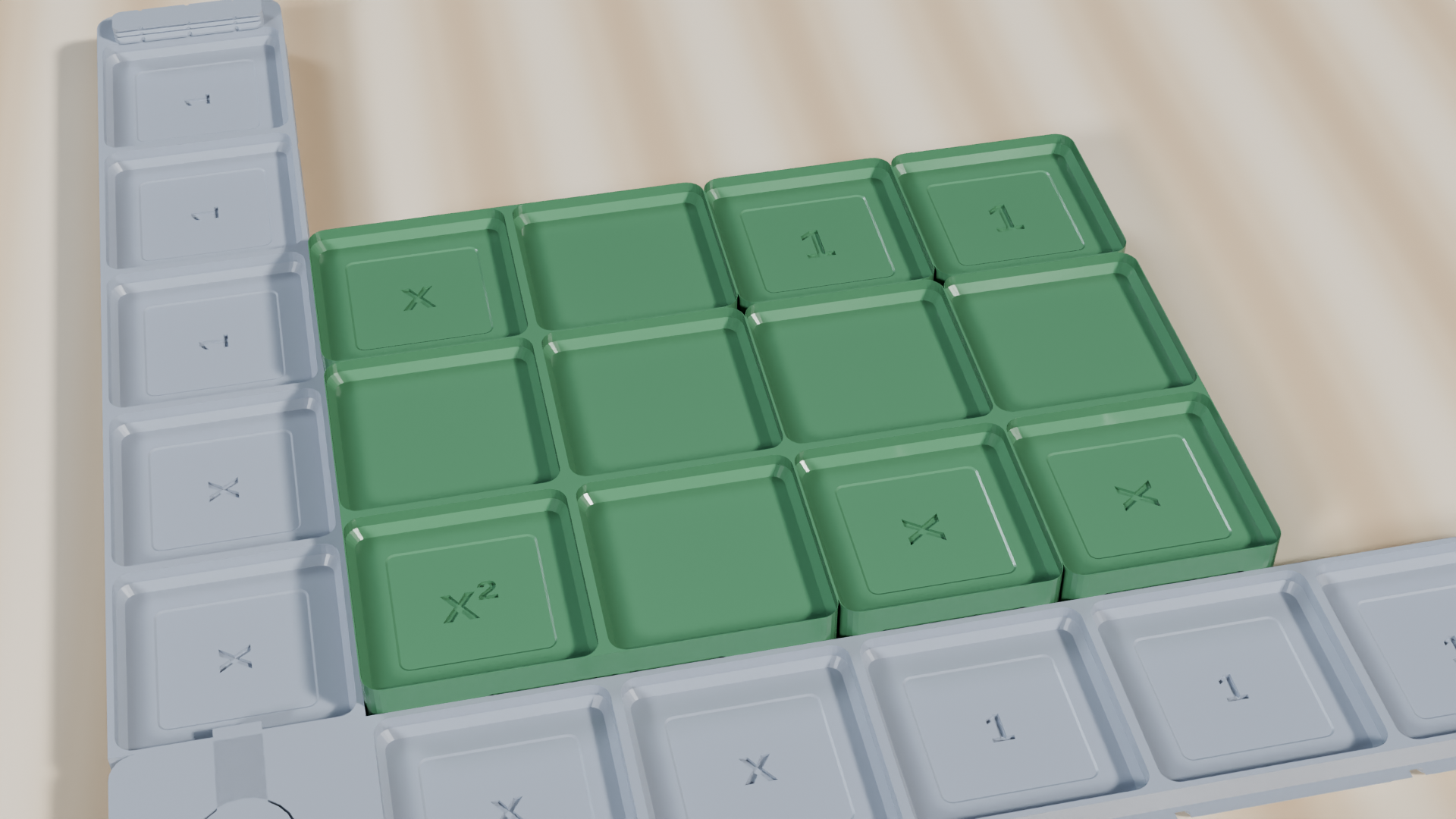
Students physically observe why "completing the square" requires adding \((\frac{b}{2})^2\): they build a symmetrical L-shape around \(x^2\) and discover the exact missing corner tile.
The Video Showcase: Mechanical Animation, Unboxing & Classroom Lesson
Experience the complete journey from precision CAD kinematics and zero-plastic unboxing to tactile algebra instruction on a classroom desk.
Mechanical & CAD Animation
Exploded 3D view showing coordinate rail dovetails, chamfered snap-fit tolerances, and modular 3x1 Gridfinity nesting.
FOIL Area Model: (x+2)(x+1)
Step-by-step tiling showing x², three x-bars, and two unit squares forming a closed geometric rectangle with area x² + 3x + 2.
Trinomial Factoring on L-Frame
Taking x² + 5x + 6 and arranging tiles into a gap-free rectangle against the 90° rails to reveal factors (x + 2) and (x + 3).

Archival Reference & Video QR Card (135×90mm)
Included inside every box. Scan Side B to jump straight to this 3-video learning portal or inspect Side A for part replacement IDs.
From the Teacher's Manual: Unit Lab Sheet
Most traditional math teacher manuals treat manipulatives as optional afterthoughts. In the StackCalc curriculum, every manipulative unit includes a dedicated, reproducible lab sheet connecting hands-on tactile geometry directly to hardware calculator execution.
Lab 04: The Geometric Area Model & RPN Polynomial Verification
Investigation Goal: Prove that polynomial multiplication is the physical calculation of a rectangle's area. Construct the tactile geometric expansion of \((x + 2)(x + 1)\), formulate the trinomial, and verify factor equivalence across the entire real number line using the SC-32 RPN stack.
Lock the 90° mortise-and-tenon L-frame rails together on your desk. Dimension the Base Rail to \((x + 2)\) using one \(x\) rod and two \(1\) units. Dimension the Height Rail to \((x + 1)\) using one \(x\) rod and one \(1\) unit.
| Binomial Factors | x² Squares Count | x Rods Count | Unit Squares Count | Expanded Polynomial Form |
|---|---|---|---|---|
| \((x + 2)(x + 1)\) | 1 tile (\(x^2\)) | 3 rods (\(3x\)) | 2 units (\(2\)) | \(x^2 + 3x + 2\) |
| \((x + 3)(x + 2)\) | 1 tile (\(x^2\)) | 5 rods (\(5x\)) | 6 units (\(6\)) | \(x^2 + 5x + 6\) |
Choose any test scalar (e.g. \(x = 5\)). Evaluate both the factored side-lengths and the tiled polynomial area on the SC-32 4-register RPN stack to prove mathematical identity:
Build a Complete Hands-On Algebra Station
Research demonstrates that students retain algebraic concepts 40% faster when tactile manipulatives are paired with structured problem workbooks and zero-distraction RPN hardware calculators.
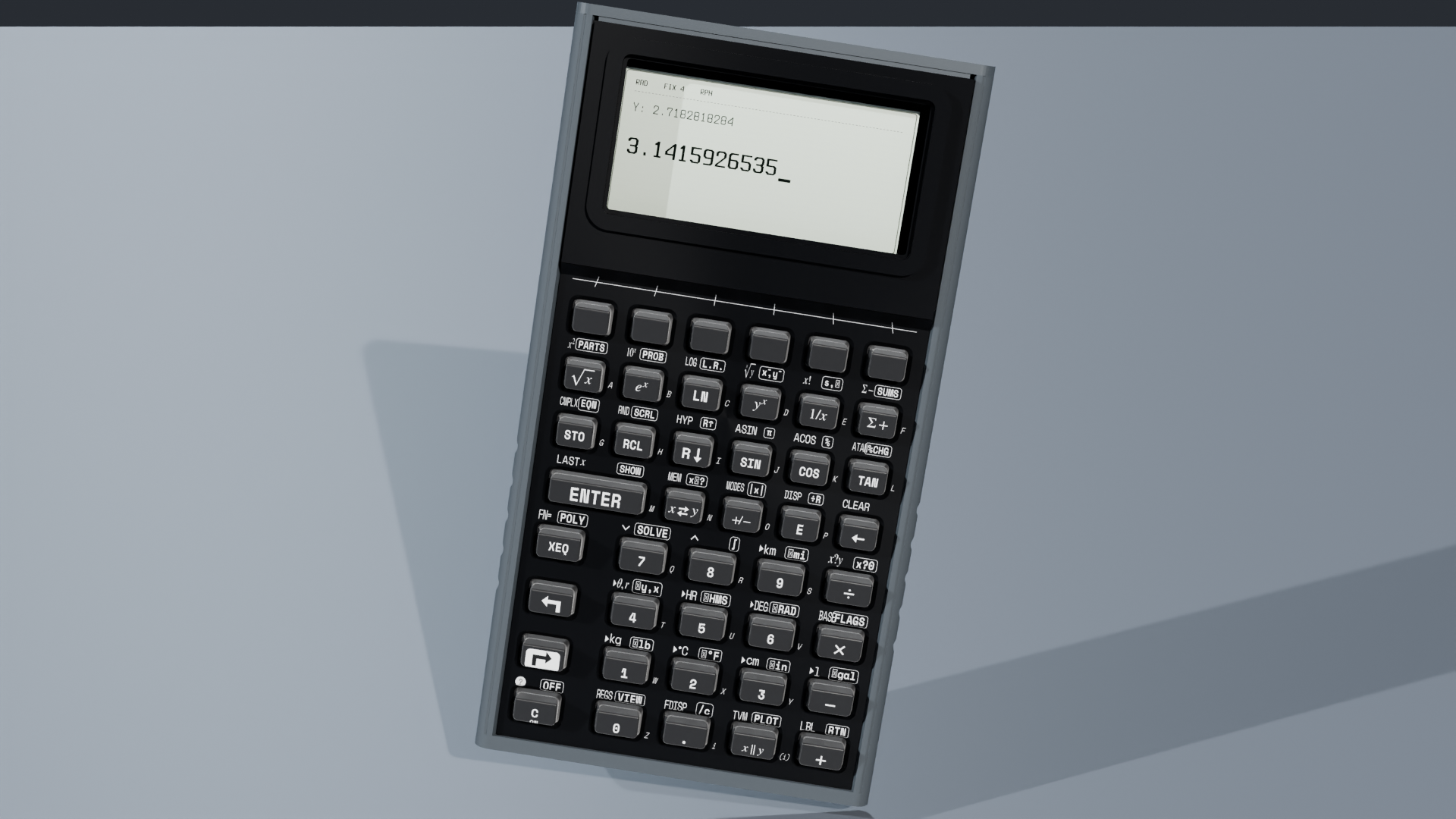
SC-32 Scientific RPN Maker Kit
The hardware math engine for classroom focus. Instant power-on, zero wireless radios (100% exam legal), and 4-register RPN stack evaluating polynomial roots with zero parentheses syntax errors.
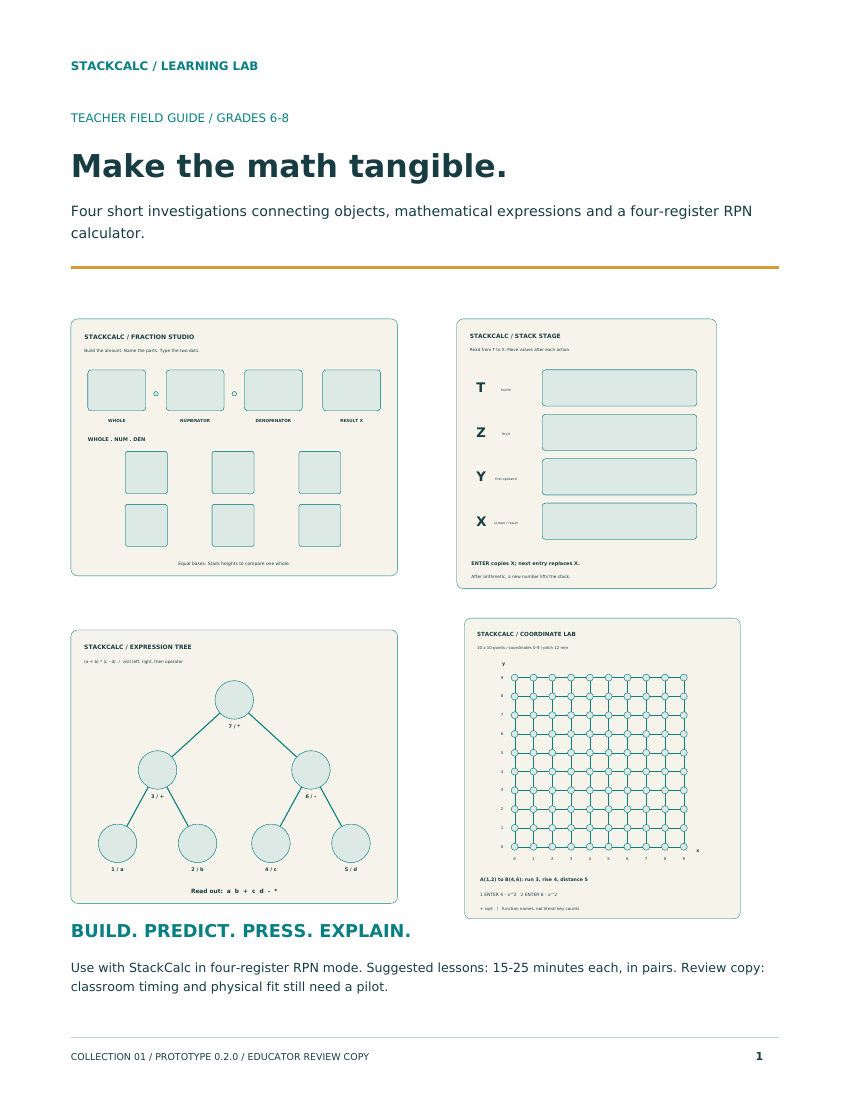
36-Page Spiral Student Workbook
20 ready-to-teach STEM laboratory investigations. Features full-color illustrated diagrams, reproducible student sheets, and complete teacher answer keys for Algebra 1 and Pre-Calculus.
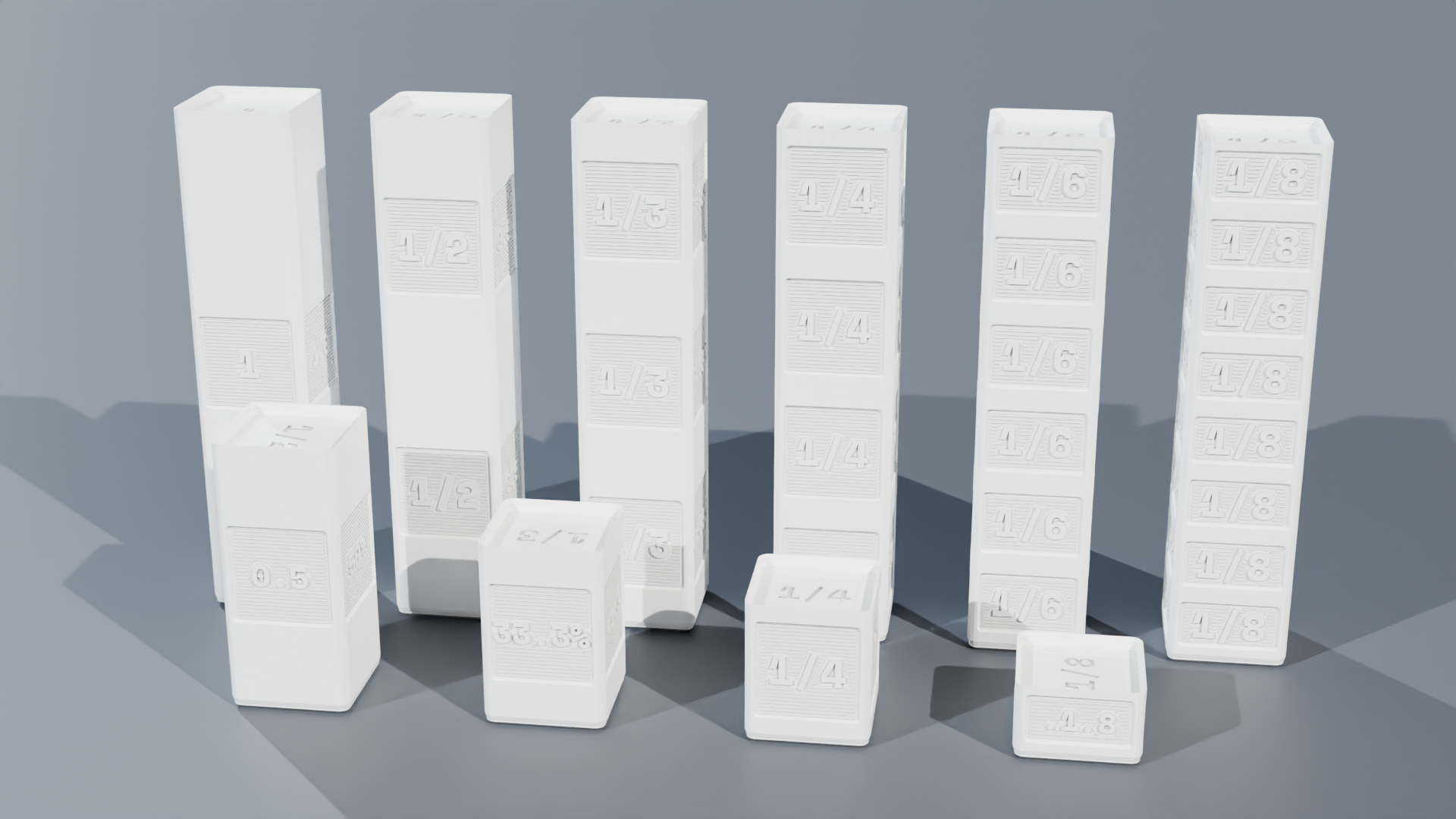
Fraction Studio
Precision 84.0mm datum towers covering binary, ternary, and decimal subdivisions. Bridges arithmetic fractions into algebraic rational expressions.
Technical Specifications
Precision proportions and tile dimensions.
| Outer Box Dimensions | 126.0 mm (L) × 42.0 mm (W) × 36.0 mm (H) • Standard 3x1 Gridfinity footprint |
| Factoring Stage Rails | Dual grooved coordinate guidance tracks for factor positioning along X and Y axes |
| Polynomial Tiles (30 Total) | 2× \(x^2\) large squares (\(38.6 \times 38.6\,\text{mm}\)), 10× \(x\) rods (\(38.6 \times 19.0\,\text{mm}\)), 18× unit \(1\) squares (\(19.0 \times 19.0\,\text{mm}\)) |
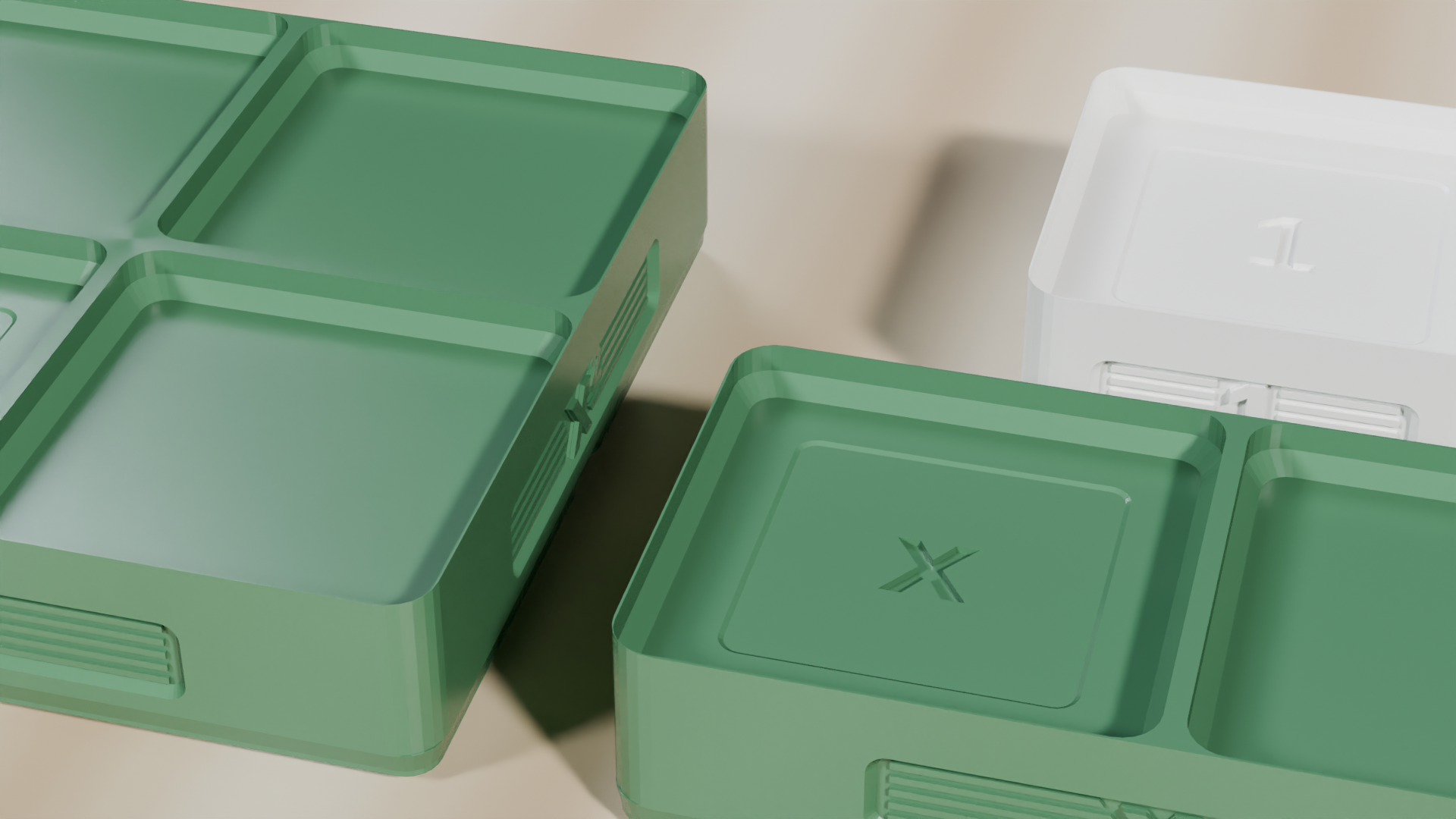
| Tile Annotations | Tactile debossed math notation with 45° perimeter bevels and corner thumb-lift notches |
| Industrial Design & CMF | Precision classroom biopolymer • ±0.15 mm interlocking fit tolerance • 45° finger-relief edge bevels • Debossed mathematical legends |
| Curriculum Standards | Common Core: CCSS.MATH.CONTENT.HSA.SSE.A.2, HSA.APR.A.1 • TEKS: 111.39.c.10 • CA Framework Grades 7–11 |
| Procurement Classification | UNSPSC: 60101700 (Math Manipulatives) • Eligible for Federal Title I and Title IV STEM Grant Funding |
What's in the Box
Complete hands-on polynomial factoring station.
Safety, Compliance & Guarantees
Engineered for safe classroom environments and reliable long-term instruction.
WARNING: CHOKING HAZARD – Small parts. Not for children under 3 years. This product contains small tactile tiles (\(19.0 \times 19.0\,\text{mm}\)). Designed specifically for educational instruction for Grades 3+ (ages 8 and up) under adult supervision.
Manufactured exclusively from odorless, non-toxic, BPA-free PLA biopolymer and impact-resistant PETG. Free from lead, PVC, and phthalates. Wipe clean with standard classroom disinfectant wipes.
Classrooms and homes are busy spaces. If a tile or rail ever goes missing or gets damaged, order individual replacement parts anytime for just $2.49 with free envelope shipping.
Designed and manufactured by StackCalc in California under strict dimensional tolerances and quality control.
Pedagogical Verification & Classroom Architecture
Geometric area modeling, perimeter retention rails, and rapid 15-second inventory verification.
Tactile Area Modeling
Physically constructs binomial products and quadratic factors as discrete 2D rectangular areas. Converts abstract FOIL procedures into visual and spatial proofs.
Factoring Retention Rails
Integrated perimeter stage rails align tile factors along orthogonal axes without shifting or sliding across desk surfaces during multi-student collaborative proofs.
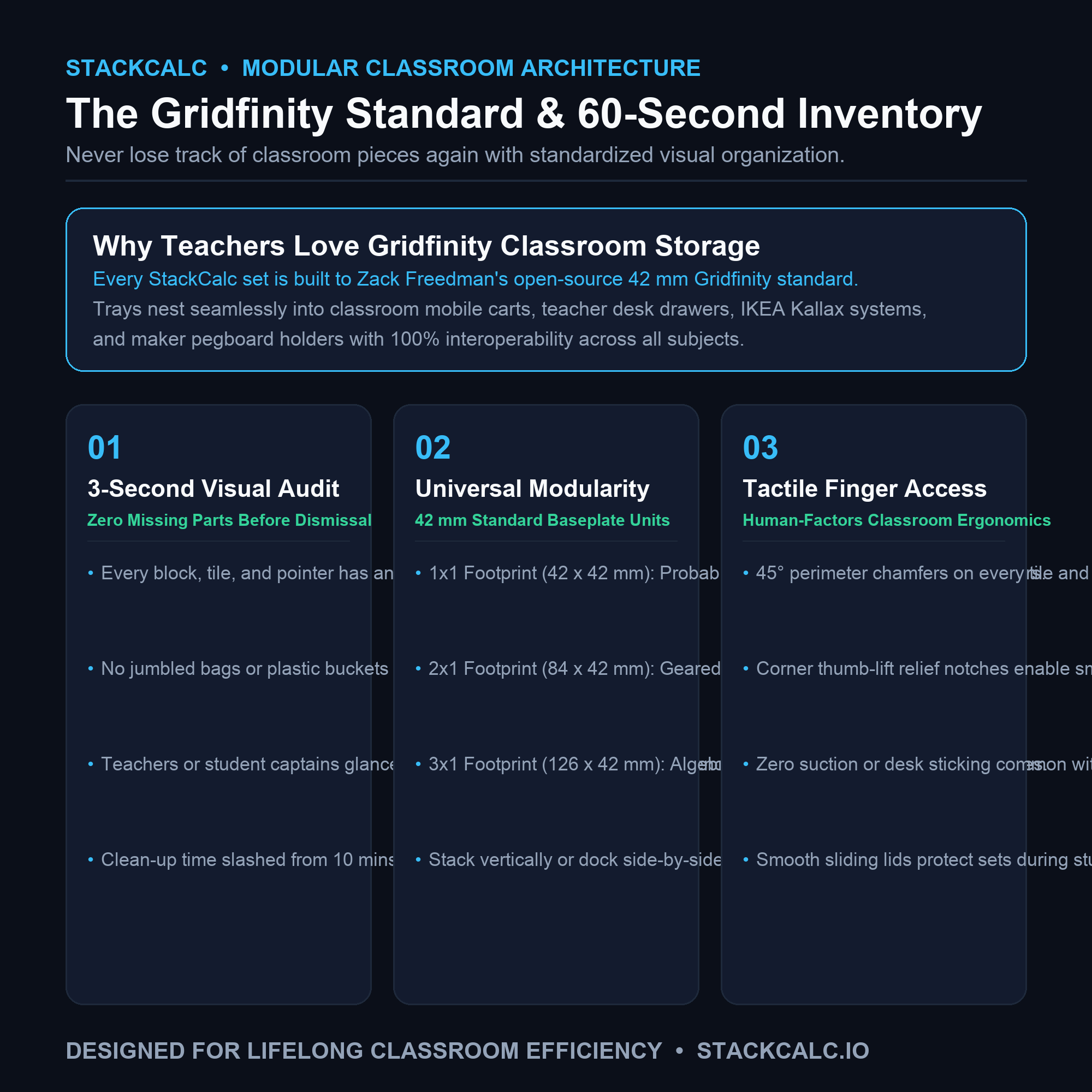
Gridfinity 3×1 Organization
Every piece has a molded recess inside the 3×1 Gridfinity box. Teachers and students complete a full 35-piece visual audit in under 15 seconds before dismissing class.
Frequently Asked Questions
Everything you need to know about classroom deployment, standards, and durability.
How does the geometric area model help with quadratic factoring? +
Rather than relying on abstract memorization of binomial FOIL rules, students arrange physical side factor rails (e.g. \(x + 2\) and \(x + 3\)) and physically tile the interior rectangle with \(x^2\), \(x\), and unit tiles. The trinomial equation \(x^2 + 5x + 6\) becomes an intuitive rectangular puzzle.
Which educational standards does the Algebra Factoring Studio meet? +
The kit directly aligns with Common Core State Standards CCSS.MATH.CONTENT.HSA.SSE.A.2 and HSA.APR.A.1, Texas Essential Knowledge and Skills (TEKS 111.39.c.10), and the California Mathematics Framework for Grades 7–11. It is classified under UNSPSC 60101700 and qualifies for Federal Title I and Title IV Part A grant funding.
How do schools sanitize and clean the tiles? +
All components are manufactured from waterproof, non-porous PLA biopolymer and PETG. They can be sanitized using standard hospital-grade classroom disinfectant wipes or washed in lukewarm soapy water (up to 50°C / 120°F).
What is the "Anti-Heartbreak" lifetime guarantee? +
We understand that classroom manipulatives can occasionally get lost or swept away. Under our Anti-Heartbreak lifetime guarantee, educators and parents can request individual matching replacement tiles or rails anytime for just $2.49 with free envelope shipping.
3D Print Algebra Boxes
Download our print-tested STL files for the Gridfinity factoring box and all 35 polynomial tiles.
Algebra Boxes bridge concrete spatial factoring to algebraic equations. Once students master quadratic factorization geometrically, they easily solve and evaluate complex polynomials using the dedicated stack on our SC-32 scientific calculator.