Chapter 6: The Square-Cube Law, Solid Geometry & Three-Dimensional Space
In 1638, while confined under house arrest at his villa in Arcetri outside Florence, Galileo Galilei opened the modern science of strength of materials in his final treatise, Two New Sciences (Discorsi e dimostrazioni matematiche intorno a due nuove scienze) (Galilei, 1638). Galileo had been struck by a puzzle from the Venetian Arsenal: when Renaissance shipwrights doubled every linear timber dimension of a wooden naval hull from a scale model to a full-sized galleon, the larger vessel cracked on its launch ways under its own dead weight. Extruding flat two-dimensional cross-sections into solid three-dimensional matter exposes a structural divergence between second-power surface area and third-power volume, now known as the Square-Cube Law. When a cylindrical rocket tank of radius \(r\) and wall thickness \(t\) holds gas at internal pressure \(P\), the outward pressure load \(Pr\) per unit length is borne by the metal wall of thickness \(t\), creating a circumferential hoop stress \(\sigma_\theta = Pr/t\); if a cryogenic stage doubles every linear tank dimension at fixed wall thickness \(t\), its internal propellant capacity octuples (\(2^3 = 8\)) while its hoop stress \(\sigma_\theta = Pr/t\) doubles with \(r\).
6.1 Galileo's Square–Cube Scaling & Planar Mensuration
When any three-dimensional solid—such as a cantilever bridge girder, a thin-walled cryogenic pressure vessel, a biological skeleton, or a silicon microprocessor—has every linear dimension (length, width, and height) scaled by a dimensionless multiplier \(\ell\), its surface area \(A\) grows with the square of \(\ell\) and its enclosed volume \(V\) grows with the cube of \(\ell\) (using \(\propto\) for "is proportional to"):
As the linear dimensions of a structural beam or machine casing scale by \(\ell\), its cross-sectional and exterior surface area multiply by \(\ell^2\), while its enclosed volume and gravitational mass multiply by \(\ell^3\), dividing the specific area-to-volume ratio \(A/V\) by \(\ell\). Tensile and compressive load capacity depend on cross-sectional area (\(A \propto \ell^2\)): when an axial force \(F\) pulls or presses on a column, that load is distributed across the interatomic bonds spanning the cross-sectional area \(A\) to produce an axial normal stress \(\sigma = F/A\), and convective or radiative heat rejection likewise scales with exposed surface area (\(A \propto \ell^2\)). Self-weight, kinetic energy storage, and volumetric heat generation, however, scale with enclosed volume (\(V \propto \ell^3\)).
If a structural frame or organism is scaled up geometrically by \(\ell = 10\), its load-bearing cross-sections multiply by \(10^2 = 100\) while its dead weight multiplies by \(10^3 = 1,000\), subjecting every square millimeter of bone or steel to tenfold specific stress (\(\sigma \propto \ell^3 / \ell^2 = \ell\)). Because terminal velocity in air occurs where gravitational weight (\(\propto \ell^3\)) balances quadratic aerodynamic drag (\(\propto A v^2 \propto \ell^2 v^2\)), impact velocity scales as \(v_{\text{term}} \propto \sqrt{\ell}\). Consequently, large structures cannot remain geometrically similar to small prototypes: just as Galileo showed that large vertebrates require disproportionately thick columnar limbs, a civil engineer scaling a \(1:50\) wind-tunnel bridge model up to full span must replace solid bars with hollow box girders and wide-flange I-beams that concentrate material far from the neutral axis.
6.1.1 The Thermal Wall: Surface Area (\(L^2\)) vs. Volume (\(L^3\))
The inverse scaling \(A/V \propto 1/\ell\) also governs thermal survival across biology and modern electronics. Inside a high-performance microprocessor, billions of nanometer-scale transistors switch at gigahertz frequencies and produce localized thermal flux exceeding \(100\text{ W/cm}^2\), a power density approaching the heat flux inside a nuclear reactor core. To carry that thermal power \(\dot{Q}\) away into a moving fluid, a cooling system relies on the convective heat-transfer coefficient \(h\) of the moving airstream or liquid coolant, the exposed boundary surface area \(A_{\text{surface}}\) in contact with the fluid, and the temperature excess of the hot solid wall \(T_{\text{solid}}\) above the surrounding fluid \(T_{\text{ambient}}\), as governed by Newton's Law of Cooling (Incropera et al., 2007):
The temperature gap \((T_{\text{solid}} - T_{\text{ambient}})\) drives heat outward at a flux of \(h\) watts per square meter per kelvin, and \(A_{\text{surface}}\) integrates that flux across the entire exterior skin. Because internal heat generation scales with enclosed volume (\(\propto \ell^3\)) while convective heat removal \(\dot{Q}\) is limited by the exposed surface area \(A_{\text{surface}}\) (\(\propto \ell^2\)), scaling up any heat-producing machine or organism causes volume-generated heat (\(L^3\)) to outpace the surface area (\(L^2\)) available to shed it, forcing the wall temperature \(T_{\text{solid}}\) upward into a thermal bottleneck. In warm-blooded biology, this scaling contrasts metabolic torpor in hummingbirds with vascular radiators in elephants. A \(3\text{-gram}\) ruby-throated hummingbird (\(\ell \approx 2\text{ cm}\)) has a high surface-area-to-volume ratio (\(A/V \propto 1/\ell\)). It loses body heat across its skin so rapidly relative to its small thermal mass that its heart must beat \(1,200\text{ times per minute}\) by day, and it must enter deep hypothermic torpor at night to avoid starving before dawn.
At the opposite extreme, a \(5,000\text{-kilogram}\) African elephant (\(\ell \approx 200\text{ cm}\), a \(100\times\) linear scale-up over the hummingbird) generates \(100^3 = 1,000,000\times\) the internal metabolic heat while possessing only \(100^2 = 10,000\times\) the skin surface area. With \(1/100\text{th}\) the relative cooling area, an elephant would overheat if evolution had not departed from geometric similarity by equipping it with thin, vascularized ear-fins that act as biological radiators.
A silicon CPU package faces the same thermal constraint, which engineers resolve with extruded pin-fin arrays. An unmachined aluminum block offers little surface area; extruding it into dozens of thin parallel fins cuts volume and mass while multiplying the exposed convective boundary area \(A_{\text{surface}}\) by \(300\%\) to \(2,500\%\). This geometry overcomes Galileo's Square-Cube Law by folding additional surface area into the same footprint.
In real-world mechanical design, aerospace enclosures, heat sinks, and structural castings are never isolated cubes. They are bounded by dozens of planar walls, sloped frustum roofs, cylindrical bosses, and cutout apertures. Auditing the total cooling area or structural weight of a composite solid is therefore an accounting ledger problem: summing the areas of every exterior rectangular wall, circular boss, and trapezoidal facet while deducting the areas of drilled mounting holes and window cutouts.
6.1.2 Circular Sectors, Annuli & Regular Polygons
Every three-dimensional cross-section or enclosure boundary begins with two-dimensional planar figures, ranging from rectangles, triangles, trapezoids, and circles to circular sectors, circular segments, ellipses, parabolic arches, and regular \(n\)-gons. Factoring differences of squares (\(R^2 - r^2 = (R - r)(R + r)\)) and exploiting geometric symmetry simplify these planar formulas and preserve numerical precision.
The circular annulus is the flat ring formed by a pipe flange gasket, a thrust washer, or a hollow cylindrical wall bounded by outer radius \(R\) and inner bore radius \(r\). Evaluating \(\pi R^2 - \pi r^2\) term by term multiplies by \(\pi\) twice and loses significant digits when the wall is thin (\(R \approx r\)), because squaring two nearly equal radii and subtracting them cancels their leading digits. Factoring the difference of squares eliminates both the duplicate multiplication and the near-cancellation:
Geometrically, this factored form says that if you snip a circular ring and unroll it, its exact area equals its average circumference \(2\pi R_{\text{mean}}\) multiplied by its radial wall thickness \(t = R - r\). For a steel pipe flange annulus with outer radius \(R = 15\text{ cm}\) and bore radius \(r = 10\text{ cm}\), the factored product \(\pi(5)(25)\) yields \(A_{\text{ann}} \approx \mathbf{392.699\text{ cm}^2}\).
When an angular wedge of central angle \(\theta\) (measured in radians, where \(\theta = \theta_{\text{deg}} \cdot \pi/180\) is the ratio of rim arc length \(s\) to radius \(r\)) is sliced from a disk of radius \(r\), its curved outer rim has arc length \(s = r\theta\) and the pizza-slice wedge forms a circular sector of area \(A_{\text{sector}}\). Snapping a straight secant chord across the two outer corners of that wedge splits the sector into an inner isosceles triangle (whose two radial legs \(r\) meet at angle \(\theta\)) and an outer bowed circular segment of area \(A_{\text{segment}}\)—the crescent-shaped cap bounded by the circular arc and the straight chord (such as a milled shaft keyway flat, an arched optical aperture, or the liquid cross-section in a horizontal cylindrical tank):
Treating the sector as a radial fan of curved base \(s = r\theta\) and height \(r\) gives the half-base-times-height area \(A_{\text{sector}} = \frac{1}{2}rs = \frac{1}{2}r^2\theta\). Subtracting the inner isosceles triangle of base \(r\) and altitude \(r\sin\theta\) (area \(\frac{1}{2}r^2\sin\theta\)) from that full wedge leaves \(A_{\text{segment}} = \frac{1}{2}r^2(\theta - \sin\theta)\) for the bowed cap beyond the chord. On a circular sector cam of radius \(r = 12\text{ cm}\) and central angle \(\theta = 60^\circ = \pi/3 \approx 1.047\text{ rad}\), the arc length is \(s \approx \mathbf{12.566\text{ cm}}\) and the sector area is \(A_{\text{sec}} \approx \mathbf{75.398\text{ cm}^2}\). For an arched cylindrical vault window of radius \(r = 8\text{ m}\) subtending a central chord angle \(\theta = 1.25\text{ rad}\), subtracting the sine from the radian angle and scaling by \(\frac{1}{2}r^2 = 32\text{ m}^2\) yields the circular segment area \(A_{\text{seg}} = 32(1.25 - \sin 1.25) \approx \mathbf{9.632\text{ m}^2}\).
Every regular \(n\)-sided polygon of side length \(s\) decomposes into \(n\) congruent isosceles triangles radiating from its center, each with central apex angle \(2\pi/n\). Dropping a perpendicular altitude from the center to the midpoint of one side \(s\) bisects that wedge into two right triangles with apex half-angle \(\pi/n\) and opposite leg \(s/2\). In that right triangle, the adjacent leg is the inradius or apothem \(r_{\text{in}}\) (the radius of the inscribed circle, and half the wrench distance across flats when \(n\) is even), the hypotenuse from center to vertex is the circumradius \(R_{\text{out}}\) (the radius of the circumscribed circle), and summing all \(n\) wedges yields the polygon area \(A_n\):
Multiplying the half-side \(s/2\) by \(\cot(\pi/n)\) projects the opposite leg onto the adjacent apothem \(r_{\text{in}}\), while dividing \(s/2\) by \(\sin(\pi/n)\) stretches it along the radial hypotenuse \(R_{\text{out}}\); summing the \(n\) radial triangles of area \(\frac{1}{2}s\,r_{\text{in}}\) then equates the polygon area \(A_n\) to half the perimeter \(ns\) times the apothem \(r_{\text{in}}\). For a regular hexagon (\(n = 6,\; \pi/6 = 30^\circ\)), the dimensionless area multiplier is \(\frac{6}{4}\cot(30^\circ) = \frac{3\sqrt{3}}{2} \approx 2.598\); across a regular hexagonal flange of side length \(s = 5\text{ cm}\), \(\cot(30^\circ) = \sqrt{3} \approx 1.732\) yields apothem \(r_{\text{in}} \approx \mathbf{4.33\text{ cm}}\) and area \(A_6 = \frac{3\sqrt{3}}{2}(25) \approx \mathbf{64.952\text{ cm}^2}\). When an instrument cover or structural gusset is a regular octagon (\(n = 8\)) of side length \(s\), \(\cot(\pi/8) = \cot(22.5^\circ) = 1 + \sqrt{2} = \delta_S \approx 2.414\)—the classical silver ratio, which satisfies \(\delta_S^2 = 2\delta_S + 1\) and \(1/\delta_S = \delta_S - 2 = \sqrt{2} - 1\)—so its area follows directly from square dissection without a trigonometric lookup. A regular octagon is a bounding square of width \((1 + \sqrt{2})s = \delta_S s\) that has had four \(45^\circ\text{–}45^\circ\text{–}90^\circ\) right-isosceles corner triangles of leg \(s/\sqrt{2}\) clipped off its four corners:
Each clipped corner triangle removes \(\frac{1}{2}(s/\sqrt{2})^2 = \frac{1}{4}s^2\), so all four corners together deduct \(s^2\) from the bounding square area \((3 + 2\sqrt{2})s^2\) to leave \(2(1 + \sqrt{2})s^2 = 2\delta_S s^2\).
6.1.3 Ellipse Perimeters & Earth's Equatorial Bulge
In classical geometry, the area of an ellipse and its perimeter differ sharply in analytical complexity. Because an ellipse with semi-major axis \(a\) and semi-minor axis \(b\) is a circle of radius \(b\) stretched along one axis by the factor \(a/b\), its area scales by that same factor: \(A = \pi b^2 \cdot (a/b) = \pi a b\) (for an elliptical inspection port with \(a = 250\text{ mm},\; b = 150\text{ mm}\), multiplying \(\pi a b\) yields \(A \approx \mathbf{117,809.725\text{ mm}^2}\)). Yet if you ask for the perimeter (circumference) \(P\) of that same ellipse, no closed-form expression in elementary functions exists anywhere in mathematics: setting up the arc-length integral \(\int \sqrt{dx^2 + dy^2}\) leads to an irreducible complete elliptic integral of the second kind, \(P = 4a E(e)\), governed by the eccentricity \(e = \sqrt{1 - b^2/a^2}\).
To approximate the perimeter \(P\) algebraically, Srinivasa Ramanujan parameterized the departure from circularity by the dimensionless symmetric flattening ratio \(h = (a - b)^2 / (a + b)^2\):
When \(a = b\), the parameter \(h\) vanishes and the leading factor \(\pi(a + b)\) recovers the exact circumference \(2\pi a\) of a circle with mean radius \((a + b)/2\); as the ellipse elongates (\(h > 0\)), the rational-radical correction \(\frac{3h}{10 + \sqrt{4 - 3h}}\) stretches that baseline circumference to track the elliptic integral. A power-series expansion of the complete elliptic integral for the perimeter of an ellipse in terms of \(h\) gives \(P = \pi(a+b)\left[1 + \frac{1}{4}h + \frac{1}{64}h^2 + \frac{1}{256}h^3 + \frac{25}{16384}h^4 + \frac{49}{65536}h^5 + \dots\right]\). Expanding the nested radical in a Taylor series, \(\frac{3h}{10 + \sqrt{4 - 3h}} = \frac{1}{4}h + \frac{1}{64}h^2 + \frac{1}{256}h^3 + \frac{25}{16384}h^4 + \frac{45}{65536}h^5 + \dots\), matches the exact elliptic integral through the \(h^1, h^2, h^3\), and \(h^4\) terms (\(\frac{25}{16384}h^4\)), first differing at the \(h^5\) coefficient (\(\frac{45}{65536}h^5\) vs. \(\frac{49}{65536}h^5\)) by just \(\frac{4}{65536} = \frac{1}{16384}h^5\). For an elliptical cam with \(a = 10\text{ cm}\) and \(b = 5\text{ cm}\) (\(h = 1/9 \approx 0.111\)), evaluating \(3h / (10 + \sqrt{4 - 3h})\) and scaling by \(\pi(a + b) = 15\pi\text{ cm}\) yields \(P \approx \mathbf{48.442\text{ cm}}\), matching the exact elliptic integral to nine significant digits.
That axial difference \((a - b)\) between semi-major and semi-minor axes also governs the shape of rotating planets. Because the Earth rotates once every \(23\text{ hours } 56\text{ minutes}\), centrifugal acceleration forces ocean and mantle outward at the equator and deforms our planet from a sphere into an oblate spheroid with equatorial semi-major axis \(a\) and polar semi-minor axis \(b\). Geodesists express this polar compression by the dimensionless flattening \(f\) and its reciprocal \(1/f\):
Expressing the equatorial-minus-polar radial bulge \((a - b)\) as a fraction of the equatorial radius \(a\) defines \(f\), while its reciprocal \(1/f\) counts how many times that bulge fits into Earth's equatorial radius. Because the Mississippi River flows southward toward Earth's equatorial bulge, its mouth at the Gulf of Mexico sits roughly four miles farther from the center of the Earth than its headwaters at Lake Itasca.
6.1.4 Semiperimeter Area, Incircles & the Shoelace Determinant
When a surveyor in the field measures the three boundary lengths \((a, b, c)\) of a triangular parcel using a steel tape or laser rangefinder, finding the parcel's area from \(A = \frac{1}{2}bh\) would normally require solving for an interior angle via the Law of Cosines and then taking a sine to find the perpendicular altitude \(h\). Heron's semiperimeter formula bypasses trigonometry by defining the semiperimeter \(s\) as half the triangle's perimeter:
Each factor \((s - a)\), \((s - b)\), and \((s - c)\) measures how much half the perimeter exceeds a single side, which means the radicand contains a built-in physical check: by the Euclidean triangle inequality, the sum of any two sides of a real triangle must exceed the third (\(a + b > c\), which means \(s > c\) and \((s - c) > 0\)). If a misread blueprint specifies three lengths that cannot possibly close into a triangle—say \(3, 4\), and \(9\), where \(s = 8\) and \((s - 9) = -1 < 0\)—the factor \((s - c)\) turns negative and the negative radicand exposes the impossible geometry.
For any cyclic quadrilateral (a four-sided figure inscribed in a circle) with sides \((a, b, c, d)\) and semiperimeter \(s = (a + b + c + d)/2\), Brahmagupta's formula gives the enclosed area as \(A = \sqrt{(s - a)(s - b)(s - c)(s - d)}\). Letting the fourth side shrink to a point (\(d \to 0\)) reduces that four-factor radical to Heron's triangle formula \(A = \sqrt{s(s - a)(s - b)(s - c)}\).
The semiperimeter \(s\) also governs the inscribed circle of a triangle. Dropping an incircle of radius \(r\) inside any triangle so that it touches all three sides tangentially, and drawing lines from the incenter to the three vertices, partitions the triangle into three smaller triangles of heights \(r\) and bases \(a, b, c\), whose areas sum to \(\frac{1}{2}ar + \frac{1}{2}br + \frac{1}{2}cr = \left(\frac{a+b+c}{2}\right)r = s \cdot r\). Thus, for every triangle:
Dividing the enclosed area \(A\) by the semiperimeter \(s\) therefore yields the inscribed circle radius \(r\) of any triangle. When the triangle happens to be a right triangle with orthogonal legs \(a\) and \(b\) and hypotenuse \(c = \sqrt{a^2 + b^2}\), the tangent segments around the \(90^\circ\) corner simplify \(r = A/s\) into the linear relation \(r = \frac{a + b - c}{2}\): because the two tangent segments at the right angle form a square of side \(r\), the remaining segments \((a - r)\) and \((b - r)\) fold onto the hypotenuse so that \((a - r) + (b - r) = c\).
When a parcel's corners are specified by Cartesian survey coordinates \((x_1, y_1)\) and \((x_2, y_2)\) relative to an origin monument, the Shoelace Theorem multiplies diagonally across a two-column coordinate table (\(x_1 y_2\) downward-right minus \(y_1 x_2\) upward-right) in a criss-cross pattern like lacing a boot. That cross-product gives the signed parallelogram area spanned by the two vectors as the \(2 \times 2\) determinant \(D = \det\begin{bmatrix} x_1 & y_1 \\ x_2 & y_2 \end{bmatrix} = x_1 y_2 - y_1 x_2\), whose half-magnitude \(A = \frac{1}{2}|D|\) is the enclosed triangle area. When a surveyor needs to locate the exact intersection corner \((x, y)\) where two straight property boundary lines \(a_1 x + b_1 y = c_1\) and \(a_2 x + b_2 y = c_2\) cross—defined by their normal coefficients \((a_1, b_1)\) and \((a_2, b_2)\) and right-hand offset constants \((c_1, c_2)\)—that same \(2 \times 2\) determinant solves the simultaneous linear system via Cramer's Rule:
Geometrically, the determinant \(D = a_1 b_2 - b_1 a_2\) measures the signed parallelogram area spanned by the two line normals—vanishing (\(D = 0\)) whenever the boundary lines run parallel and never meet—while \(D_x = c_1 b_2 - b_1 c_2\) and \(D_y = a_1 c_2 - c_1 a_2\) substitute the offset constants \((c_1, c_2)\) for the \(x\)- or \(y\)-coefficients, expressing each intersection coordinate as a ratio of two parallelogram areas.
6.2 Cavalieri's Principle, Three-Dimensional Solids & Rotational Inertia
If twenty coins are stacked into a vertical cylinder on a desk and then nudged sideways so the column leans over or curves into an S-shape, the total volume of the stack does not change by a single cubic millimeter. Cavalieri's Principle states that if two solids have the same total height, and if slicing them parallel to their bases at every height \(z\) reveals cross-sections of identical area \(A(z)\) (or a constant ratio of areas), then their total volumes must be identical (or stand in that same ratio).
When a solid of total vertical height \(h\) has a horizontal cross-sectional area \(A(z)\) that varies as any linear, quadratic, or cubic function of height \(z\), its exact volume \(V\) follows from just three parallel horizontal slices—the bottom base area \(A_{\text{bottom}}\) at \(z = 0\), the mid-height cross-section \(A_{\text{mid}}\) halfway up at \(z = h/2\), and the top roof area \(A_{\text{top}}\) at \(z = h\)—via Simpson's Universal Prismoidal Formula (Figure 6.1):
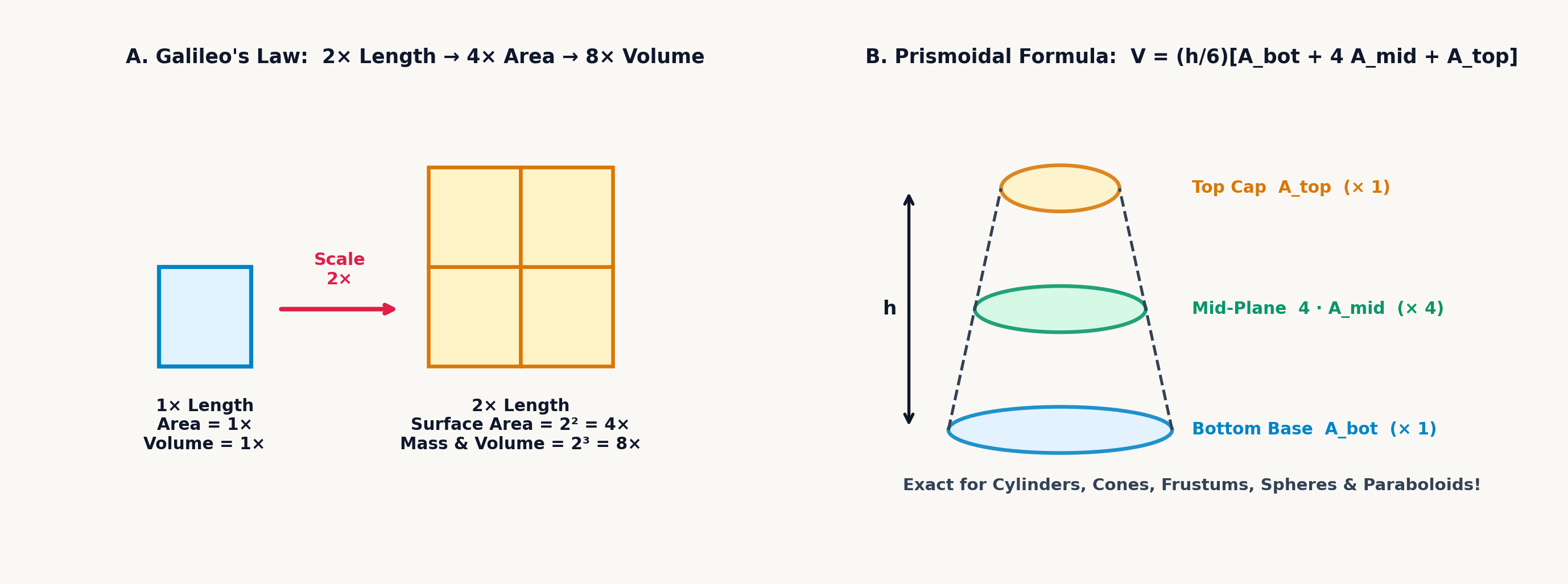
Weighting the bottom base, the mid-height slice, and the top roof in the \(1 : 4 : 1\) ratio forms an effective average cross-section \(\frac{1}{6}(A_{\text{bottom}} + 4A_{\text{mid}} + A_{\text{top}})\) across \(1 + 4 + 1 = 6\) parts of weight—assigning two-thirds weight (\(\frac{4}{6}\)) to the midsection \(A_{\text{mid}}\) where the bulk of the solid resides—and multiplying that average area by the total height \(h\) yields the exact volume \(V\). Cavalieri's Principle and Simpson's three-slice rule unify the classical volume formulas of solid geometry. When any pyramid or cone is sliced horizontally at distance \(z\) below its apex, its linear dimensions grow linearly with \(z/h\), so its cross-sectional area grows quadratically as \(A(z) = A_{\text{base}}(z/h)^2\). Because the average value of \((z/h)^2\) from \(0\) to \(h\) is \(\frac{1}{3}\) (which also follows from dissecting a cube into three identical square pyramids meeting at one corner), every cone or pyramid encloses one-third the volume of its bounding prism or cylinder, \(V = \frac{1}{3}A_{\text{base}}h\), whether its base is a circle, a square, an octagon, or an ellipse (\(A_{\text{base}} = \pi ab\), where \(V = \frac{1}{3}\pi abh\)). Likewise, a paraboloid of revolution whose radius grows as \(r(z) \propto \sqrt{z}\) has cross-sectional area \(A(z) \propto z\), whose average from \(0\) to \(h\) is one-half (\(V = \frac{1}{2}\pi r^2 h\)).
By Cavalieri's slice principle, a sphere of radius \(r\) inscribed inside a right circular cylinder of radius \(r\) and height \(h = 2r\) encloses two-thirds (\(\frac{2}{3}\)) of the cylinder's volume. When the top hemisphere of radius \(r\) is placed beside a cylinder of radius \(r\) and height \(r\) that has had an inverted \(45^\circ\) cone (\(r_{\text{cone}}(z) = z\)) carved out of its center, and both solids are sliced at height \(z\) above the equator, the Pythagorean theorem shows that the hemisphere's slice is a disk of radius \(\sqrt{r^2 - z^2}\) and area \(\pi(r^2 - z^2)\).
At the same height \(z\), the punctured cylinder's slice is an annulus of outer radius \(r\) and inner hole radius \(z\), whose area is also \(\pi(r^2 - z^2)\). Because every horizontal slice matches in area, the hemisphere's volume equals the cylinder minus the cone: \(\pi r^3 - \frac{1}{3}\pi r^3 = \frac{2}{3}\pi r^3\). Doubling for both hemispheres gives \(V_{\text{sphere}} = \frac{4}{3}\pi r^3 = \frac{2}{3}(2\pi r^3) = \frac{2}{3}V_{\text{cylinder}}\); decomposing the sphere into radial pyramids of height \(r\) and base areas summing to \(A_{\text{sphere}}\) (\(V_{\text{sphere}} = \frac{1}{3}r A_{\text{sphere}}\)) then establishes that its surface area \(A_{\text{sphere}} = 4\pi r^2\) is likewise \(\frac{2}{3}\) of the cylinder's total area (\(2\pi r^2 + 2\pi r(2r) = 6\pi r^2\)).
When two equal circular cylinders of radius \(r\) intersect at a \(90^\circ\) right angle, as in a high-pressure refinery cross-joint or a groin vault, the common volume forms a Steinmetz bicylinder. Slicing the bicylinder horizontally at height \(z\), where both cylinders have half-width \(\sqrt{r^2 - z^2}\), produces a square cross-section of side \(2\sqrt{r^2 - z^2}\) and area \(4(r^2 - z^2)\); an inscribed sphere's slice is a circle of area \(\pi(r^2 - z^2)\). At every slice from bottom to top, the bicylinder's square slice is \(\frac{4}{\pi}\) times the sphere's circular slice, so by Cavalieri's Principle \(\pi\) cancels out of the volume.
A second \(\pi\)-free solid is the cylindrical ungula (hoof)—the wedge formed when a right circular cylinder of radius \(r\) is sliced by an inclined plane passing through a base diameter at angle \(\alpha\) (reaching rim height \(h = r\tan\alpha\)), whose vertical slices perpendicular to the diameter are right triangles integrating to \(\frac{2}{3}r^2 h\):
Even though both solids are bounded by curved cylindrical walls, neither volume contains \(\pi\). For \(r = 6\text{ cm}\) and \(\alpha = 45^\circ\) (\(h = 6\text{ cm}\)), the ungula encloses \(V_{\text{ungula}} = \mathbf{144\text{ cm}^3}\) and the bicylinder encloses \(V_{\text{bicylinder}} = \mathbf{1,152\text{ cm}^3}\).
When a cone or pyramid is sliced flat at height \(h\) before reaching its apex, with bottom radius \(R\) (or base area \(A_1\)) and top radius \(r\) (or top area \(A_2\)), the resulting frustum has volume \(V_{\text{pyr,frust}} = \frac{h}{3}(A_1 + A_2 + \sqrt{A_1 A_2})\) and \(V_{\text{cone,frust}} = \frac{1}{3}\pi h(R^2 + Rr + r^2)\). Physically, the frustum's volume equals its height \(h\) multiplied by the arithmetic average of three areas: the bottom base \(A_1 = \pi R^2\), the top base \(A_2 = \pi r^2\), and their geometric mean \(\sqrt{A_1 A_2} = \pi Rr\). On a concrete bridge-pier pyramidal frustum with \(A_1 = 36\text{ m}^2,\; A_2 = 16\text{ m}^2\), and \(h = 9\text{ m}\), the three areas \(36\), \(16\), and \(\sqrt{36 \times 16} = 24\text{ m}^2\) combine with \(\frac{h}{3} = 3\text{ m}\) to yield \(V = \mathbf{228\text{ m}^3}\).
In the volume (\(V = 2\pi^2 R r^2\)) and surface area (\(A = 4\pi^2 R r\)) of a torus—an O-ring gasket with major orbit radius \(R\) and minor tube cross-section radius \(r\) (\(R \ge r\))—the constant \(\pi\) appears squared (\(\pi^2 \approx 9.87\)) because two orthogonal circles are multiplied together. By Pappus's Centroid Theorems, when a planar curve of arc length \(L\) or a planar region of area \(A_{\text{cross}}\) is revolved around a coplanar external axis that does not intersect the curve or region, the surface area swept out equals \(L\) multiplied by the circumference \(2\pi R_{\text{cm,arc}}\) traveled by the curve's arc-length centroid, and the enclosed volume equals \(A_{\text{cross}}\) multiplied by the circumference \(2\pi R_{\text{cm,area}}\) traveled by the region's area centroid:
For a torus, the generating circle has circumference \(L = 2\pi r\) and disk area \(A_{\text{cross}} = \pi r^2\), while its centroid travels a circle of length \(2\pi R\), yielding \(A = 4\pi^2 R r\) and \(V = 2\pi^2 R r^2\) without evaluating an integral. For an O-ring with \(R = 45\text{ mm}\) and \(r = 3.5\text{ mm}\), \(A \approx \mathbf{6,217.851\text{ mm}^2}\) and \(V = A \cdot r / 2 \approx \mathbf{10,881.239\text{ mm}^3}\).
Two-dimensional space admits infinitely many regular polygons, yet three-dimensional space permits only five regular convex polyhedra: the 4-faced tetrahedron, 6-faced cube, 8-faced octahedron, 12-faced dodecahedron, and 20-faced icosahedron (for an icosahedral crystal of edge \(a = 18\text{ mm}\), \(V = \frac{5(3+\sqrt{5})}{12}a^3 \approx \mathbf{12,723.645\text{ mm}^3}\)). The volume coefficient \(\frac{\sqrt{2}}{12}a^3\) of a regular tetrahedron of edge length \(a\) follows from inscribing it inside a cube of edge length \(c = a/\sqrt{2}\) (so each face diagonal has length \(\sqrt{2}c = a\)). The space outside the tetrahedron consists of four right-angled corner pyramids, each having three mutually perpendicular legs of length \(c\) and volume \(\frac{1}{3}\left(\frac{1}{2}c^2\right)c = \frac{1}{6}c^3\). Slicing off those four corners removes \(4 \times \frac{1}{6} = \frac{2}{3}\) of the cube, so the central tetrahedron retains \(1 - \frac{2}{3} = \frac{1}{3}\) of the cube's volume: \(V = \frac{1}{3}c^3 = \frac{1}{3}\left(\frac{a}{\sqrt{2}}\right)^3 = \frac{\sqrt{2}}{12}a^3\).
Every convex polyhedron with \(V\) vertices, \(E\) edges, and \(F\) faces satisfies Euler's polyhedral invariant:
When a polyhedron's wireframe is projected radially onto a rubber sphere, punctured through one face, and flattened onto a plane, this topological invariant becomes visible: removing each edge merges two faces (\(\Delta E = -1, \Delta F = -1\), which preserves \(V - E + F\)), and contracting a tree of \(V\) vertices and \(V - 1\) edges to a single point yields \(1 - 0 + 1 = 2\). At every vertex of a convex polyhedron, at least \(3\) faces must meet, and their flat corner angles must sum to less than \(360^\circ\) so the faces fold into a 3D corner instead of lying flat. Equilateral triangles (\(60^\circ\)) allow \(3, 4,\) or \(5\) faces per vertex (tetrahedron, octahedron, icosahedron); squares (\(90^\circ\)) allow \(3\) (cube); and regular pentagons (\(108^\circ\)) allow \(3\) (dodecahedron). At six sides, three regular hexagons meet at \(3 \times 120^\circ = 360^\circ\) and lie flat in a plane, precluding any regular polyhedron with six or more sides per face.
6.2.1 Spherical Shells, Geodesy & Additive Manufacturing
Curved shells and planetary surfaces follow three additional mensuration laws for spherical caps, spherical triangles, and triaxial ellipsoids. In petrochemical refineries, liquefied gases are stored inside spherical Hortonsphere tanks of radius \(R\) because a sphere resists internal pressure with uniform membrane tension (half the hoop stress of a cylinder of equal radius). When an ultrasonic sensor measures liquid depth \(h\) at the bottom of the sphere, integrating horizontal disk slices of squared radius \(r^2(z) = R^2 - (R-z)^2 = 2Rz - z^2\) from \(z = 0\) to \(h\) gives the spherical cap volume \(V_{\text{cap}}\), while the curved exterior shell of height \(h\) forms a spherical dome of surface area \(A_{\text{dome}}\), and slicing the sphere between two parallel planes of radii \(r_1\) and \(r_2\) separated by vertical thickness \(h\) encloses the spherical zone volume \(V_{\text{zone}}\):
Expanding the cap volume as \(V_{\text{cap}} = \pi R h^2 - \frac{1}{3}\pi h^3\) shows how the spherical-curvature taper \(-\frac{1}{3}\pi h^3\) trims the leading paraboloid approximation \(\pi R h^2\). By Archimedes' hat-box projection, the curved surface area \(A_{\text{dome}} = (2\pi R)h\) of any spherical cap or zone depends only on the sphere's radius \(R\) and the vertical slice height \(h\): as a horizontal ring at latitude \(\theta\) approaches the pole, its horizontal radius \(R\cos\theta\) shrinks by \(\cos\theta\) while its sloped meridian width \(dz/\cos\theta\) stretches by the reciprocal \(1/\cos\theta\), canceling at every latitude so the dome has the exact same area as a band of height \(h\) on the circumscribing cylinder of circumference \(2\pi R\).
Splitting the zone volume into \(V_{\text{zone}} = \frac{1}{2}\pi(r_1^2 + r_2^2)h + \frac{1}{6}\pi h^3\) likewise separates the average of the two flat end-cap cylinders, \(\frac{1}{2}(\pi r_1^2 + \pi r_2^2)h\), from the outward spherical bulge \(\frac{1}{6}\pi h^3 = \frac{4}{3}\pi(h/2)^3\)—the exact volume of a complete sphere of diameter \(h\). For a spherical cap of \(R = 10\text{ cm}\) and depth \(h = 3\text{ cm}\), \(V_{\text{cap}} \approx \mathbf{254.469\text{ cm}^3}\) and \(A_{\text{dome}} \approx \mathbf{188.496\text{ cm}^2}\); for a spherical zone with \(r_1 = 8\text{ cm}, r_2 = 6\text{ cm}, h = 4\text{ cm}\), \(V_{\text{zone}} \approx \mathbf{661.829\text{ cm}^3}\).
On a flat plane, the interior angles of every triangle sum to \(180^\circ\) (\(\pi\text{ rad}\)), whether the triangle is drawn on a postage stamp or across a field. On a curved sphere of radius \(R\), however, great-circle paths bow outward, and the interior angles \((\alpha, \beta, \gamma)\) of a spherical triangle always sum to more than \(180^\circ\). Starting at the North Pole, walking south to the Equator along the Prime Meridian, turning \(90^\circ\) west along the Equator to \(90^\circ\text{ W}\), and turning \(90^\circ\) north back to the North Pole traces a spherical triangle with three \(90^\circ\) right angles (\(\alpha + \beta + \gamma = 270^\circ\)) enclosing one-eighth of the globe (\(\frac{1}{8}\cdot 4\pi R^2 = \frac{\pi}{2}R^2\)).
That angle sum and the enclosed surface area are locked together by Girard's Theorem on intersecting great circles. When two great circles slice through opposite poles at a dihedral wedge angle \(\theta_{\text{rad}}\) (in radians), they carve the sphere into crescent-shaped orange-peel wedges called spherical lunes; because a full \(2\pi\text{ rad}\) revolution sweeps out the entire sphere area \(4\pi R^2\), a lune of dihedral angle \(\theta_{\text{rad}}\) encloses the fraction \(\frac{\theta_{\text{rad}}}{2\pi}(4\pi R^2)\), or \(A_{\text{lune}} = 2R^2\theta_{\text{rad}}\). Overlaying the three lune pairs covering the three corner angles \((\alpha, \beta, \gamma)\) of a spherical triangle covers the entire sphere once while triple-covering the triangle itself and its antipodal twin, proving that the spherical excess \(E_{\text{rad}} = (\alpha + \beta + \gamma) - \pi\) (the radian amount by which the three corner angles exceed \(180^\circ\)) is directly proportional to the triangle's area \(A_{\text{triangle}}\):
Converting the degree excess above \(180^\circ\) into radians \(E_{\text{rad}}\) and scaling by \(R^2\) turns angle measurements directly into surface area: on a sphere of known radius \(R\), a surveyor can determine the area of a continental triangle from its three corner angles alone without taping any boundary length.
Just as the perimeter of a 2D ellipse has no elementary closed form, the surface area \(A\) of a 3D triaxial ellipsoid with three unequal semi-axes \((a, b, c)\) (whose enclosed volume is \(V_{\text{ellipsoid}} = \frac{4}{3}\pi abc\), and whose three perpendicular coordinate-plane shadow projections are ellipses of areas \(\pi ab\), \(\pi ac\), and \(\pi bc\)) requires incomplete elliptic integrals. Knud Thomsen's power-mean formula combines the three pairwise semi-axis shadow products \((ab, ac, bc)\) using an exponent \(p \approx 1.608\):
Where a sphere of radius \(R\) has surface area \(4\pi R^2\), Knud Thomsen's formula replaces the single squared radius \(R^2\) with the \(p\)-power average of the three perpendicular semi-axis products \(ab\), \(ac\), and \(bc\)—raising each product to the power \(p \approx 1.608\), averaging the three terms inside the brackets, and extracting the \(1/p\) root to restore dimensions of area before scaling by \(4\pi\). This single expression approximates the exact elliptic surface integral to within \(1.06\%\) across all aspect ratios (for an ellipsoid with semi-axes \(a = 6\text{ cm},\; b = 4\text{ cm},\; c = 3\text{ cm}\), \(V_{\text{ellipsoid}} \approx \mathbf{301.593\text{ cm}^3}\) and \(A \approx \mathbf{231.28\text{ cm}^2}\)).
Finally, surface area and enclosed volume govern mass estimation in aerospace sandwich-composite panels and lattice-core additive manufacturing. Unlike a solid casting of material density \(\rho\) that is \(100\%\) dense throughout, a lightweight structural enclosure—like the trabecular bone of an avian wing—is a composite shell-and-core structure of total mass \(m_{\text{part}}\), pairing a solid exterior skin of area \(A_{\text{surface}}\) and thickness \(t_{\text{shell}}\) with a porous lattice core that fills the remaining interior volume \(V_{\text{interior}} = V_{\text{total}} - A_{\text{surface}}t_{\text{shell}}\) at relative infill fraction \(f_{\text{infill}}\):
Summing the solid skin volume \(A_{\text{surface}} t_{\text{shell}}\) and the effective lattice volume \(V_{\text{interior}} f_{\text{infill}}\) before multiplying by material density \(\rho\) shows why surface area dominates lightweight part weight. For thin-walled instrument housings and aerospace fairings, more than half of the structural mass resides in the exterior skin (\(A_{\text{surface}} \cdot t_{\text{shell}}\)) rather than in the cellular core: on a composite housing with \(A_{\text{surface}} = 150\text{ cm}^2\), skin thickness \(t_{\text{shell}} = 0.12\text{ cm}\), total bounding volume \(V_{\text{total}} = 98\text{ cm}^3\), and \(f_{\text{infill}} = 20\%\) core lattice density molded from polycarbonate-carbon resin (\(\rho = 1.25\text{ g/cm}^3\)), the solid skin volume \(18\text{ cm}^3\) and cellular core volume \(0.2(98 - 18) = 16\text{ cm}^3\) combine to \(34\text{ cm}^3\), yielding a finished structural mass of \(m_{\text{part}} = \mathbf{42.5\text{ g}}\).
6.2.2 Euclidean Distance, Helical Coils & Weighted Centroids
Once the surface area and volume of a three-dimensional body are established, spatial analysis turns to Euclidean distance, helical wire length, and center of mass. On a flat sheet of paper, the distance between two points \((x_1, y_1)\) and \((x_2, y_2)\) with coordinate steps \(\Delta x = x_2 - x_1\) and \(\Delta y = y_2 - y_1\) follows the 2D Pythagorean theorem \(r = \sqrt{\Delta x^2 + \Delta y^2}\). Stepping out of the flat plane by rising an elevation \(\Delta z = z_2 - z_1\) perpendicular to the floor forms a second right triangle from the floor diagonal \(r = \sqrt{\Delta x^2 + \Delta y^2}\) and the vertical rise \(\Delta z\), whose hypotenuse is the straight-line 3D Euclidean distance \(d\):
Geometrically, this 3D distance decomposes into two orthogonal right triangles in succession: first finding the diagonal shadow \(r_{xy} = \sqrt{\Delta x^2 + \Delta y^2}\) across the floor, and then tilting up from that floor diagonal by the vertical height \(\Delta z\) to reach the 3D corner. For a displacement of \((\Delta x, \Delta y, \Delta z) = (3, 4, 12)\text{ m}\), the horizontal legs \((3, 4)\text{ m}\) form a floor diagonal of \(r_{xy} = \sqrt{3^2 + 4^2} = 5\text{ m}\) (at floor azimuth \(\approx 53.13^\circ\)), and pairing that \(5\text{ m}\) floor diagonal with the vertical rise \(\Delta z = 12\text{ m}\) produces the 3D spatial diagonal \(d = \sqrt{5^2 + 12^2} = \mathbf{13\text{ m}}\) at an elevation angle of \(\phi \approx \mathbf{67.38^\circ}\).
That three-component Pythagorean sum also gives the small-taper active-coil wire blank length \(L\) required to wind a tapered conical compression spring with bottom radius \(R_1\), top radius \(R_2\), mean radius \(R_m = \frac{1}{2}(R_1 + R_2)\), axial height \(h\), and \(N\) active coils (prior to squared-and-ground end turns):
Unrolling the conical helix resolves the wire path into three locally orthogonal displacements whose squares add under the radical: \(N\) circumferential turns of unrolled length \(2\pi N R_m\) at the mean radius, the vertical axial climb \(h\), and the inward radial taper \(R_1 - R_2\) from base to top.
In three-dimensional tracking, when a deep-space radar or robotic gimbal follows a target along the 3D displacement vector \(\vec{V} = (\Delta x, \Delta y, \Delta z)\) at total slant range \(d = |\vec{V}| = \sqrt{\Delta x^2 + \Delta y^2 + \Delta z^2}\), the orientation of the beam in space is fixed by the three inclination angles \(\alpha, \beta,\) and \(\gamma\) measured between \(\vec{V}\) and the positive \(x\)-, \(y\)-, and \(z\)-axes. Projecting the slant range \(d\) onto each coordinate axis gives \(\Delta x = d\cos\alpha\), \(\Delta y = d\cos\beta\), and \(\Delta z = d\cos\gamma\), so dividing each coordinate step by the range \(d\) produces the three direction cosines \((\cos\alpha, \cos\beta, \cos\gamma) = \left(\frac{\Delta x}{d}, \frac{\Delta y}{d}, \frac{\Delta z}{d}\right)\)—the components of the 3D unit pointing vector \(\hat{u} = \vec{V}/d\):
Dividing both sides of the 3D Pythagorean equation \(\Delta x^2 + \Delta y^2 + \Delta z^2 = d^2\) by \(d^2\) normalizes the three squared axial projections so they sum to \(1\), which guarantees that the tip of the unit pointing vector \(\hat{u}\) always lies on a unit sphere of radius \(1\) and that any two direction angles determine the third.
The balance point of an asymmetric airplane wing, a welded I-beam girder, or a multi-stage rocket follows from static torque equilibrium. When a body is assembled from \(N\) components with masses (or cross-sectional areas) \(m_1, m_2, \dots, m_N\) centered at positions \(x_1, x_2, \dots, x_N\), each piece exerts a gravitational torque (first moment) \(m_k x_k\) about the origin. The composite center of mass (centroid) \(\bar{x}_{\text{cm}}\) is the exact location where a single support fulcrum balances all those torques, defined as the mass-weighted mean of the coordinates:
Summing the individual first-moment torques \(m_k x_k\) of all \(N\) components and dividing by the total assembled mass \(\sum m_k\) locates the unique coordinate \(\bar{x}_{\text{cm}}\) where concentrating the entire mass produces the same gravitational torque as the distributed parts.
6.2.3 Geometric Symmetry, Mass Distribution & Classical Mechanics
In linear motion, a \(10\text{-kilogram}\) steel block requires the same force to accelerate whether it is shaped like a compact cannonball or a thin bicycle wheel. Across classical mechanics, orbital astrodynamics, and structural engineering, however, the cross-sectional and radial geometry of cylinders, spheres, and structural beams governs how matter stores rotational kinetic energy, escapes planetary gravity, resists shaft torsion, and withstands elastic bending.
When a rigid body spins about an axis at angular velocity \(\omega\) (in radians per second, \(\text{rad/s}\)), a particle of mass \(m\) at perpendicular radial distance \(r\) from the axis sweeps along a circle at tangential speed \(v = r\omega\), turning inward with centripetal acceleration \(a_c = v^2 / r = \omega^2 r\). Substituting \(v = r\omega\) into the translational kinetic energy \(K = \frac{1}{2}mv^2\) groups the mass and its squared lever arm into the quantity \(mr^2\), whose sum (or integral \(I = \int r^2\,dm\)) across the entire body defines the rotational moment of inertia \(I\) and the rotational kinetic energy \(E_{\text{rot}}\):
The rotational moment of inertia \(I = \int r^2\,dm\) (\(\text{kg}\cdot\text{m}^2\)) plays the exact role of mass in linear motion while angular speed \(\omega\) plays the role of velocity, giving rotational kinetic energy \(E_{\text{rot}} = \frac{1}{2}I\omega^2\) and angular momentum \(L = I \omega\) (for an energy-storage flywheel of \(I = 4.25\text{ kg}\cdot\text{m}^2\) spinning at \(\omega = 150\text{ rad/s}\), \(E_{\text{rot}} = \mathbf{47,812.5\text{ J}}\)). Because the radial distance \(r\) is squared, moving a kilogram of mass twice as far from the rotation axis makes it four times harder to spin up or slow down. When a figure skater pulls her extended arms inward, cutting her effective radius \(r\) in half reduces \(I \propto r^2\) by roughly a factor of three or four; because angular momentum \(L = I\omega\) is conserved on frictionless ice, her spin rate \(\omega\) triples.
For homogeneous bodies of total mass \(M\) and outer radius \(R\) (or length \(L\), or bounded between inner bore radius \(r_1\) and outer radius \(r_2\) for a hollow cylinder, and between inner radius \(R_1\) and outer radius \(R_2\) for a hollow spherical shell), integrating \(r^2\,dm\) across the solid cross-section yields the standard form \(I = k M R^2\) (or \(k M L^2\)), where the dimensionless shape factor \(k\) measures how strongly the geometry concentrates mass away from the rotation axis:
| Homogeneous Rigid Body | Axis Orientation | Inertia Formula \(I\) | Shape Factor \(k\) |
|---|---|---|---|
| Thin Cylindrical Hoop / Rim | Symmetry axis | \(M R^2\) | \(1\) |
| Thin Spherical Shell | Any diameter | \(\dfrac{2}{3}M R^2\) | \(\dfrac{2}{3} \approx 0.667\) |
| Thick-Walled Hollow Cylinder | Symmetry axis | \(\dfrac{1}{2}M(r_1^2 + r_2^2)\) | \(\dfrac{1}{2}\left(1 + \dfrac{r_1^2}{r_2^2}\right)\) |
| Solid Circular Cylinder / Disk | Symmetry axis | \(\dfrac{1}{2}M R^2\) | \(\dfrac{1}{2} = 0.5\) |
| Solid Sphere | Any diameter | \(\dfrac{2}{5}M R^2\) | \(\dfrac{2}{5} = 0.4\) |
| Thick-Walled Spherical Shell | Any diameter | \(\dfrac{2}{5}M\dfrac{R_2^5 - R_1^5}{R_2^3 - R_1^3}\) | \(\dfrac{2}{5}\dfrac{1 - (R_1/R_2)^5}{1 - (R_1/R_2)^3}\) |
| Slender Uniform Rod (Length \(L\)) | Transverse through CM | \(\dfrac{1}{12}M L^2\) | \(\dfrac{1}{12} \approx 0.083\) |
| Slender Uniform Rod (Length \(L\)) | Transverse through end pivot | \(\dfrac{1}{3}M L^2\) | \(\dfrac{1}{3} \approx 0.333\) |
A solid circular cylinder (\(I = \frac{1}{2}MR^2\)) averages \(r^2\) over disk rings \(dA = 2\pi r\,dr\), while a solid sphere (\(I = \frac{2}{5}MR^2\)) tapers toward its poles so that more of its volume lies closer to the spin axis; if a solid cylinder and a solid sphere roll down an inclined plane from rest, the sphere converts a smaller fraction of its potential energy into rotational spin and always wins the race. A mechanical punch-press flywheel, by contrast, concentrates over three-quarters of its cast iron into a thick outer rim supported by a thin inner web so that nearly \(90\%\) of its rotational inertia comes from the outer rim. In three dimensions, a thick-walled deep-ocean bathysphere bounded by inner radius \(R_1\) and outer radius \(R_2\) integrates \(r^2\,dm\) across concentric spherical shells to scale with the fifth-power difference \(I_{\text{shell}} = \frac{2}{5}M\frac{R_2^5 - R_1^5}{R_2^3 - R_1^3}\).
At the planetary scale, spherical volume \(V = \frac{4}{3}\pi R^3\), mean planetary density \(\rho\), and Newton's universal gravitational constant \(G \approx 6.674 \times 10^{-11}\text{ m}^3/(\text{kg}\cdot\text{s}^2)\) govern gravitational binding and orbital escape energy. By the gravitational shell theorem, a spherical planet of radius \(R\) and mass \(M = \frac{4}{3}\pi R^3 \rho\) attracts an exterior spacecraft of mass \(m\) with force \(G M m / R^2\) as if all planetary mass were concentrated at its center. Setting that inward gravitational pull \(G M m / R^2\) equal to the required centripetal force \(m v_{\text{orb}}^2 / R\) defines low-altitude circular orbital speed \(v_{\text{orb}}\), while equating the spacecraft's kinetic energy \(\frac{1}{2}m v_{\text{esc}}^2\) to the depth of the gravitational potential well \(G M m / R\) defines the parabolic escape velocity \(v_{\text{esc}}\):
Canceling the spacecraft mass \(m\) leaves both speeds governed solely by the ratio of the planetary gravitational parameter \(GM\) to the surface radius \(R\). A satellite in circular orbit at \(v_{\text{orb}} = \sqrt{GM/R}\) already carries kinetic energy \(\frac{1}{2}mv_{\text{orb}}^2 = \frac{1}{2}\frac{GMm}{R}\), half the gravitational binding energy \(\frac{GMm}{R}\) needed to climb to infinity, so multiplying its orbital speed by \(\sqrt{2}\) doubles its kinetic energy and breaks it free of the planet. Substituting \(M = \frac{4}{3}\pi R^3\rho\) into \(\sqrt{2GM/R}\) cancels one power of \(R\) against \(R^3\) and pulls \(R = \sqrt{R^2}\) outside the radical: because enclosed mass grows with volume (\(R^3\)) while surface distance grows linearly (\(R\)), escape velocity scales linearly with planetary radius (\(v_{\text{esc}} \propto R\sqrt{\rho}\)), so doubling a rocky world's radius at constant density quadruples its surface escape energy.
When a rigid body of total mass \(M\) and center-of-mass inertia \(I_{\text{cm}}\) pivots about an axis displaced by perpendicular distance \(d\) from its center of mass, one need not re-integrate \(\int r^2\,dm\) from scratch. Because the cross-term in \((r_{\text{cm}} + d)^2 = r_{\text{cm}}^2 + 2d\,r_{\text{cm}} + d^2\) vanishes around the centroid (\(\int r_{\text{cm}}\,dm = 0\)), the Parallel-Axis Theorem adds the point-mass transfer term \(M d^2\) to yield the displaced inertia \(I_{\text{parallel}}\):
Adding the orbital transfer term \(Md^2\)—the inertia of the entire mass \(M\) revolving at distance \(d\) around the new pivot—to the centroidal inertia \(I_{\text{cm}}\) shifts the rotation axis in a single step. If the pivot of a slender robotic arm link of mass \(m\) and length \(L\) moves from its midpoint (\(I_{\text{cm}} = \frac{1}{12}mL^2\)) to its shoulder joint (\(d = L/2\)), the parallel-axis term adds \(m(L/2)^2 = \frac{1}{4}mL^2 = 3I_{\text{cm}}\), quadrupling the rotational inertia to \(I_{\text{pivot}} = \frac{1}{3}mL^2\).
The same \(r^2\) geometric weighting governs the elastic strength of drive shafts and structural beams when cross-sectional area \(dA\) replaces mass \(dm\). When a circular steel shaft of length \(L\) and material shear modulus of rigidity \(G\) (in pascals, measuring the atomic lattice's stiffness against shearing distortion) twists through a total angle \(\theta\) (in radians) under engine torque \(T\), elastic shear strain grows linearly with radial distance \(\rho\) from the centerline. As a result, the core metal near \(\rho \approx 0\) carries almost no torque while adding dead weight, whereas the peak shear stress \(\tau_{\max}\) occurs at the outermost surface radius \(R_o\).
Torsional stiffness grows with the fourth power of radius because radial distance \(\rho\) reinforces a concentric ring of metal in three ways at once: a ring at twice the radius has twice the circumference (\(dA = 2\pi\rho\,d\rho \propto \rho\)), it twists through twice the shear strain so it develops twice the restoring shear stress (\(\tau \propto \rho\)), and that stress acts at twice the lever arm (\(\rho\)) about the centerline. Multiplying circumference, shear stress, and lever arm together (\(\rho \times \rho \times \rho\,d\rho = \rho^3\,d\rho\)) and integrating across a solid shaft of radius \(r\) (or a hollow tubular shaft from inner bore radius \(R_i\) to outer radius \(R_o\)) yields the fourth-power area polar moment of inertia \(J\) (\(\text{m}^4\)), which governs both the outer-fiber shear stress \(\tau_{\max}\) and the end-to-end twist angle \(\theta\):
Subtracting the fourth power of the inner bore \(R_i^4\) from \(R_o^4\) in \(J_{\text{hollow}}\) removes the low-leverage core while keeping nearly all the outer rim's stiffness—which is why hollow bamboo stalks, avian wing bones, and tubular bicycle frames resist twisting nearly as well as solid rods of the same diameter at a fraction of the weight. Increasing the polar moment \(J\) directly reduces both the outer-fiber shear stress \(\tau_{\max} = TR_o/J\) driven by torque \(T\) at the surface radius \(R_o\) and the end-to-end twist angle \(\theta = TL/(GJ)\) accumulated along shaft length \(L\) against torsional rigidity \(GJ\). For a solid steel automotive half-shaft of radius \(r = 0.025\text{ m}\), length \(L = 1.2\text{ m}\), and shear modulus \(G = 79.3\times 10^9\text{ Pa}\) under torque \(T = 450\text{ N}\cdot\text{m}\), \(J \approx \mathbf{6.136\times 10^{-7}\text{ m}^4}\) yields \(\tau_{\max} \approx \mathbf{18.335\text{ MPa}}\) and \(\theta \approx \mathbf{0.011\text{ rad}}\) (\(\approx 0.636^\circ\)).
Under classical elastic beam flexure theory, when a horizontal rectangular beam of width \(b\) and depth \(h\)—or a symmetric wide-flange I-beam of outer flange width \(B\), total depth \(H\), central web thickness \(t_w\), and inner web clear height \(h_w\)—carries a bending moment \(M_{\text{bend}}\), longitudinal fibers at vertical distance \(y\) from the central neutral axis experience axial bending stress \(\sigma(y) = M_{\text{bend}} y / I_x\). Integrating \(y^2\,dA\) across the section defines the planar second moment of area \(I_x\) (\(\text{m}^4\)) and the peak outer-fiber bending stress \(\sigma_{\max}\) at the extreme top and bottom surfaces \(y = H/2\):
Bending resistance in a rectangular section (\(I_{x,\text{rect}} = \frac{1}{12}bh^3\)) grows linearly with beam width \(b\) but with the cube of vertical depth \(h^3\), while the wide-flange I-beam formula deducts the two recessed side channels of combined width \((B - t_w)\) and height \(h_w\) from the outer \(B \times H\) bounding box to counter the bending moment \(M_{\text{bend}}\) at the extreme fiber distance \(H/2\). Because bending stiffness scales with \(h^3\) at fixed width (and with the square of the aspect ratio \((h/b)^2\) when a fixed \(b \times h\) rectangular cross-section is rotated \(90^\circ\)), turning a \(4:1\) timber joist (nominal \(2\times 8\)) on edge makes it \(4^2 = 16\) times stiffer than laying it flat. Rolling structural steel into a wide-flange I-beam carves away the low-moment material near the neutral axis (\(y \approx 0\)) to concentrate cross-sectional area into the top and bottom flanges at \(y = \pm H/2\), the structural twin of a cast-iron flywheel rim.
6.3 Geometry in Four Registers: From Parcel Boundaries to Flywheels
When planar, volumetric, and inertial formulas are evaluated from their inner dimensional core outward on the four-register stack, they avoid redundant radius entry across two operational patterns:
- Single-Solid Factoring & Hypotenuse Projection (
[↰] [▸θ,r]): For a single geometric primitive (such as the annular pipe flange, the silver-ratio octagon, Heron's triangle, the frustum polynomial \(R^2 + Rr + r^2\), or the hollow drive shaft's fourth-power polar inertia \(J = \frac{\pi}{2}(R_o^4 - R_i^4)\)), factoring common multipliers (such as[↱] [π], \(\frac{1}{3}\pi h\), or \(\frac{3\sqrt{3}}{2}\)) to the outside lets the inner dimensional core accumulate inside Register \(X\) while Registers \(Z\) and \(T\) remain untouched. Whenever a right triangle or 3D slant height requires \(\sqrt{a^2 + b^2}\), staging \((Y = a,\; X = b)\) and pressing[↰] [▸θ,r](left-shifted on4) computes the hypotenuse in Register \(X\) without squaring each leg separately. - Composite Surface-Area & Centroid Ledger (
[Σ+],[↰] [Σ-],[↱] [SUMS], and[↱] [x̄,ȳ]): When auditing a multi-face casting or welded beam, clearing the statistical registers ([↰] [CLEAR]\(\to\)CLSTAT, which resets all six accumulators to0) turns[Σ+]and[↰] [Σ-](left-shifted on[Σ+]) into an additive and subtractive blueprint ledger. Evaluating each face group in Register \(X\) and pressing[Σ+](or[↰] [Σ-]to deduct a drilled cutout) increments the item counter \(n\) on screen while summing net area in \(\Sigma x\) (recalled via[↱] [SUMS], right-shifted on[Σ+], followed by the first softkeyΣx). Staging each sub-mass \(m_k\) (or sub-area \(A_k\)) in Register \(Y\) and its coordinate \(y_k\) in Register \(X\) before pressing[Σ+]prepares the first-moment ratio \(\bar{y} = \Sigma xy / \Sigma y\), which is evaluated by pressing[↱] [x̄,ȳ](right-shifted on[yˣ]) and tapping the third softkey (x̄w).
6.3.1 Planar Cross-Sections & Surveyed Triangles
This inside-out ordering keeps every intermediate result of planar ring, polygon, and geodetic sections within Registers \(Y\) and \(X\). On a high-pressure ASME B16.5 neoprene flange gasket (\(A = \pi(R^2 - r^2)\)) with outer radius \(R = 85\text{ mm}\) and inner bore radius \(r = 50\text{ mm}\), deferring the \(\pi\) multiplier avoids scaling both radii separately: squaring \(R^2 = 7,225\text{ mm}^2\) in Register \(X\), squaring \(r^2 = 2,500\text{ mm}^2\) (which lifts \(R^2\) into Register \(Y\)), subtracting to collapse the net radial span \(4,725\text{ mm}^2\) back into Register \(X\), and multiplying by \(\pi\) last yields \(A \approx \mathbf{14,844.025\text{ mm}^2}\) (\(\approx 148.44\text{ cm}^2\)).
Across a regular octagonal instrument bezel (\(A = 2(1 + \sqrt{2})s^2\)) of side length \(s = 65\text{ mm}\), constructing twice the silver ratio \(2(1 + \sqrt{2}) \approx 4.828\) in Register \(X\) first, squaring \(65^2 = 4,225\text{ mm}^2\) (lifting \(2\delta_S\) into Register \(Y\)), and multiplying yields \(A \approx \mathbf{20,400.105\text{ mm}^2}\). On the WGS-84 terrestrial semi-axes \(a = 6,378.137\text{ km}\) and \(b \approx 6,356.752\text{ km}\), subtracting \(b\) from \(a\) isolates the 3-decimal equatorial bulge \((a - b) \approx 21.385\text{ km}\) before dividing into \(a\) to return the reciprocal flattening \(1/f \approx \mathbf{298.253}\) (matching the official WGS-84 defining flattening \(1/f \approx 298.257\) when full sub-meter semi-minor precision is retained).
Heron's semiperimeter formula \(A = \sqrt{s(s-a)(s-b)(s-c)}\), which on paper appears to need four registers for \(s, (s-a), (s-b),\) and \((s-c)\) at once, runs as a Register-\(X\) accumulator once the semiperimeter \(s = (a+b+c)/2\) is stored in Variable \(S\). On a surveyed triangular gusset parcel with boundary lengths \(a = 13\text{ m}\), \(b = 14\text{ m}\), and \(c = 15\text{ m}\), storing \(s = (13 + 14 + 15)/2 = 21\text{ m}\) in Variable \(S\), multiplying the three excess factors \((21 - 13) \times (21 - 14) \times (21 - 15) = 8 \times 7 \times 6 = 336\text{ m}^3\) in place, and scaling by \(s = 21\text{ m}\) before taking the square root yields the exact parcel area \(A = \sqrt{7,056} = \mathbf{84\text{ m}^2}\), while dividing by \(S\) returns the exact inscribed circle radius \(r = A/s = 84/21 = \mathbf{4\text{ m}}\).
On a right-angled structural channel with orthogonal legs \(a = 15\text{ cm}\) and \(b = 20\text{ cm}\), evaluating the linear tangent relation \(r = \frac{a + b - c}{2}\) on \((Y, X)\) uses rectangular-to-polar conversion as a Pythagorean hypotenuse finder (\(c = \sqrt{a^2 + b^2}\)): converting \((15, 20)\) to polar form places the hypotenuse \(c = 25\text{ cm}\) in Register \(X\) (and angle \(\approx 36.87^\circ\) in Register \(Y\)); keying \(15\) and \(20\) and adding them to form the leg sum \(a + b = 35\text{ cm}\) lifts \(c = 25\text{ cm}\) into Register \(Z\) on entry and drops it back into Register \(Y\) on addition, so exchanging Registers \(X\) and \(Y\) before subtracting and halving returns the cooling-pipe inradius \(r = \mathbf{5\text{ cm}}\).
When survey corners or intersecting boundary lines are given in Cartesian coordinates, the \(2 \times 2\) determinant \(D = x_1 y_2 - y_1 x_2\) from the Shoelace Theorem and Cramer's Rule evaluates across three registers: for two parcel vectors \((x_1, y_1) = (18, 4)\text{ m}\) and \((x_2, y_2) = (6, 15)\text{ m}\), multiplying the primary diagonal \(18 \times 15 = 270\text{ m}^2\) in Register \(X\) and forming the secondary diagonal \(4 \times 6 = 24\text{ m}^2\) across Registers \(Y\) and \(X\) (which lifts \(270\) to Register \(Z\) and drops it back to Register \(Y\)) yields the signed parallelogram determinant \(D = 270 - 24 = \mathbf{246\text{ m}^2}\) and enclosed triangle area \(A = \frac{1}{2}D = \mathbf{123\text{ m}^2}\)—the same two-product difference that resolves Cramer's intersection coordinates \((x, y) = (D_x/D,\; D_y/D)\) for two survey lines \(a_1 x + b_1 y = c_1\) and \(a_2 x + b_2 y = c_2\).
6.3.2 Accumulating Composite Surface Areas & Solid Volumes
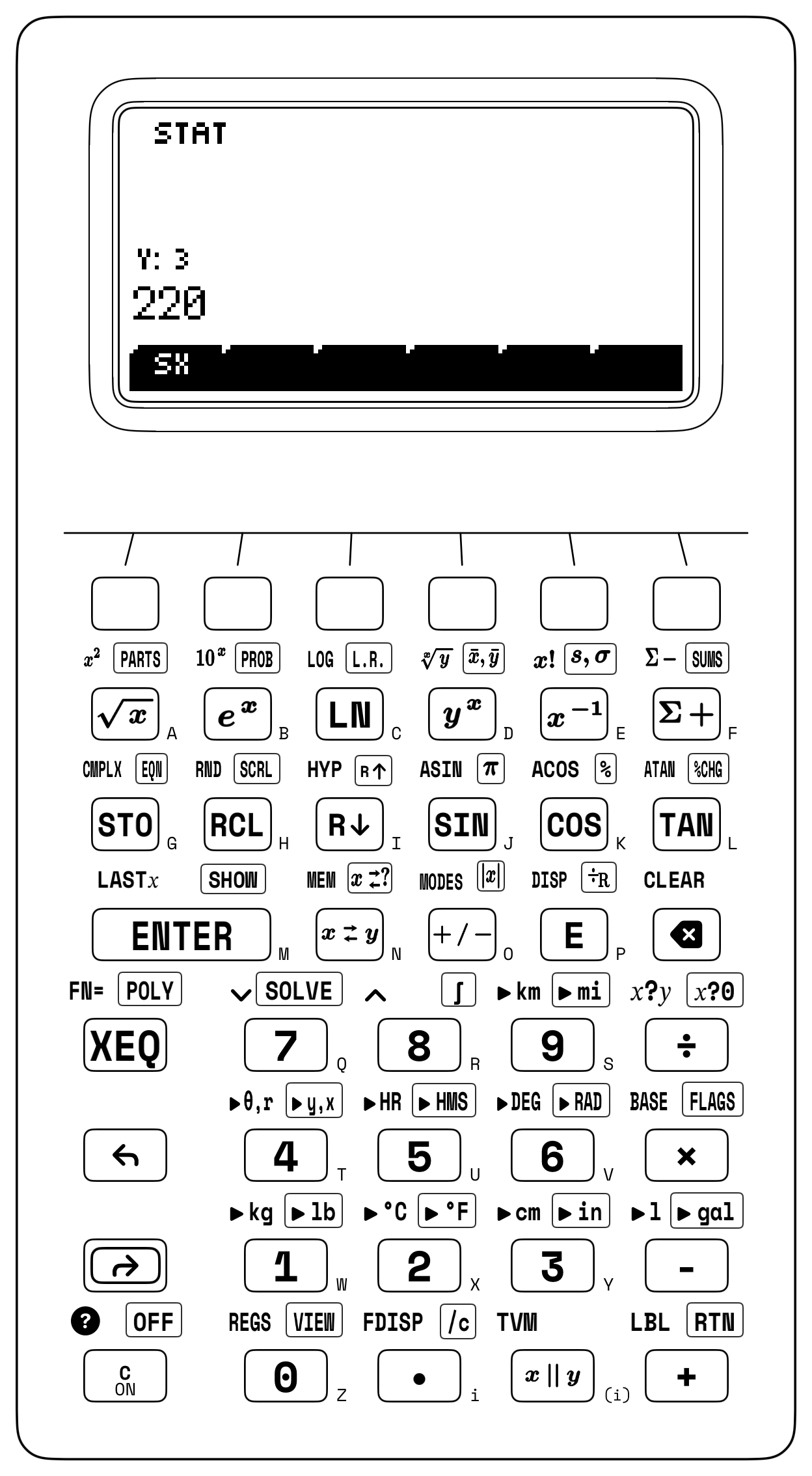
For a three-dimensional enclosure or finned casting bounded by many polygon groups, the statistical accumulator replaces manual scratchpad variables with a running ledger. Clearing the statistical registers zeros all six accumulators (\(\Sigma x = 0,\; n = 0\)); evaluating the area \(A_k\) of each face or opposing face pair in Register \(X\) and accumulating it (or subtracting to deduct a milled window aperture or cooling bore) adds \(A_k\) into \(\Sigma x\) and replaces Register \(X\) with the integer face-group counter \(n\); and recalling \(\Sigma x\) brings the net surface area back into Register \(X\).
On a \(10 \times 5 \times 4\text{ cm}\) rectangular prism, this ledger groups the six exterior walls into three opposing pairs—\(2 \times 10 \times 5 = 100\text{ cm}^2\) (\(n = 1\)), \(2 \times 10 \times 4 = 80\text{ cm}^2\) (\(n = 2\)), and \(2 \times 5 \times 4 = 40\text{ cm}^2\) (\(n = 3\))—so recalling \(\Sigma x\) returns the total surface area \(\Sigma x = \mathbf{220\text{ cm}^2}\) in Register \(X\) while the face-pair counter \(n = 3\) sits in the n register (Figure 6.2). Likewise, on the StackCalc SC-32 rectangular chassis (\(L = 148\text{ mm}\), \(W = 80\text{ mm}\), \(H = 14.5\text{ mm}\)) for an additive-manufacturing shell takeoff, accumulating top and bottom (\(2 \times 148 \times 80 = 23,680\text{ mm}^2,\; n = 1\)), side walls (\(2 \times 148 \times 14.5 = 4,292\text{ mm}^2,\; n = 2\)), and end caps (\(2 \times 80 \times 14.5 = 2,320\text{ mm}^2,\; n = 3\)) recalls \(\Sigma x = \mathbf{30,292\text{ mm}^2}\).
Because each accumulation step increments the face counter \(n\) in Register \(X\) while building the running total inside \(\Sigma x\), complex multi-step castings and thermal radiators can be audited by stepping around the blueprint. On a stepped cast-iron machine bracket (\(n = 6\) face groups) where a base block (\(120 \times 80 \times 30\text{ mm}\)) is surmounted by a centered boss (\(60 \times 40 \times 25\text{ mm}\)), subtracting the \(60 \times 40\text{ mm}\) boss footprint from the base roof and adding the boss roof back is redundant: viewed from above, the boss roof plus the surrounding ledge form one uninterrupted \(120 \times 80 = 9,600\text{ mm}^2\) top projection, so accumulating the bottom base (\(9,600\text{ mm}^2\)), long base walls (\(7,200\text{ mm}^2\)), short base ends (\(4,800\text{ mm}^2\)), long boss walls (\(3,000\text{ mm}^2\)), short boss ends (\(2,000\text{ mm}^2\)), and top projection (\(9,600\text{ mm}^2\)) yields \(\Sigma x = \mathbf{36,200\text{ mm}^2}\).
Across an 8-fin extruded aluminum CPU heat sink (\(n = 4\) face groups) where \(8\) vertical cooling fins (\(100\text{ mm}\) long, \(35\text{ mm}\) tall, \(2\text{ mm}\) thick) rise from a \(100 \times 100\text{ mm}\) square base plate, accumulating the \(16\) fin sidewalls (\(56,000\text{ mm}^2\)), the \(8\) fin top tips (\(1,600\text{ mm}^2\)), the valley floor between fins (\(8,400\text{ mm}^2\)), and the bottom mounting plate (\(10,000\text{ mm}^2\)) totals \(\Sigma x = \mathbf{76,000\text{ mm}^2}\)—a \(\mathbf{3.8\times}\) total area gain and a \(\mathbf{6.6\times}\) gain on the active air-cooled top face.
For a regular right square pyramid of base side \(s = 12\text{ mm}\) and altitude \(h = 8\text{ mm}\), the right triangle formed by \(h = 8\text{ mm}\) and base apothem \(s/2 = 6\text{ mm}\) has a \(6\text{–}8\text{–}10\) slant height of \(l = \sqrt{8^2 + 6^2} = 10\text{ mm}\); multiplying \(l = 10\text{ mm}\) by the four half-bases \(2s = 24\text{ mm}\) and adding the square base \(12^2 = 144\text{ mm}^2\) gives total surface area \(A = 384\text{ mm}^2\) in Register \(X\), and dividing by the volume \(V = \frac{1}{3}s^2 h = 384\text{ mm}^3\) confirms \(A/V = \mathbf{1\text{ mm}^{-1}}\).
Each single-solid volume and curved-shell formula from Cavalieri's principle unfolds as a one-dimensional sequence inside Register \(X\), using Register \(Y\) only transiently as terms combine. For an aerodynamic elliptic nose cone of semi-axes \(a = 24\text{ mm}\) and \(b = 15\text{ mm}\) and axial length \(h = 50\text{ mm}\), Cavalieri's one-third cone factor (\(V = \frac{1}{3}\pi abh = 6,000\pi\text{ mm}^3\)) evaluates by forming the bounding box product \(a \cdot b \cdot h = 18,000\text{ mm}^3\) in Register \(X\) and scaling by \(\pi / 3\) to return \(V \approx \mathbf{18,849.556\text{ mm}^3}\). On the Steinmetz bicylinder where two equal circular pipes of radius \(r = 15\text{ mm}\) intersect at right angles, the \(\frac{4}{\pi}\) slice ratio has already canceled \(\pi\), so evaluating \(V = \frac{16}{3}r^3 = \frac{16}{3}(3,375)\) delivers the rational volume \(\mathbf{18,000\text{ mm}^3}\), while \(A = 16r^2 = 16(225)\) gives the curved intersection surface area \(\mathbf{3,600\text{ mm}^2}\).
In a conical grain hopper of bottom radius \(R = 1.8\text{ m}\), top throat radius \(r = 0.4\text{ m}\), and height \(h = 2.5\text{ m}\), the frustum polynomial \(R^2 + Rr + r^2\) avoids re-entering radii: squaring \(R^2 = 3.24\text{ m}^2\) in Register \(X\) preserves \(1.8\) in LASTX to form the geometric-mean cross-product \(Rr = 0.72\text{ m}^2\), which in turn preserves \(0.4\) to square \(r^2 = 0.16\text{ m}^2\), summing all three terms into \(4.12\text{ m}^2\) before scaling by \(\frac{2.5\pi}{3}\) to yield \(V \approx \mathbf{10.786\text{ m}^3}\).
On prismatic machine stock, a hollow hexagonal brass bar (\(S = 20\text{ mm}\) outer flat-to-corner side, \(s = 8\text{ mm}\) inner hexagonal bore side, length \(L = 150\text{ mm}\)) pairs \((20^2 - 8^2) = 336\text{ mm}^2\) with the hexagon constant \(\frac{3\sqrt{3}}{2} \approx 2.598\) and extrudes along \(L\) to yield \(V \approx \mathbf{130,943.04\text{ mm}^3}\) (\(\approx 130.943\text{ cm}^3\)), while an inscribed regular tetrahedron of edge \(a = 50\text{ mm}\) encloses \(V = \frac{\sqrt{2}}{12}a^3 \approx \mathbf{14,731.391\text{ mm}^3}\).
Across a geodetic triangulation network on the curved Earth (\(R = 6,371\text{ km}\)) with measured interior angles \(\alpha = 82.5^\circ\), \(\beta = 68.2^\circ\), and \(\gamma = 44.7^\circ\), subtracting \(180^\circ\) from the angle sum \(195.4^\circ\) isolates the spherical excess \(E = 15.4^\circ\) (\(E_{\text{rad}} \approx 0.269\text{ rad}\)), which scales by \(R^2 = 6,371^2\text{ km}^2\) to give the spherical triangle area \(A = R^2 E_{\text{rad}} \approx \mathbf{10,909,712.316\text{ km}^2}\).
6.3.3 Three-Dimensional Centroids, Flywheels & Torsional Shafts
In three-dimensional kinematics and structural mechanics, the stack alternates between single-register Pythagorean reductions and four-register composite audits. When a tapered conical compression spring has base radius \(R_1 = 30\text{ mm}\), top radius \(R_2 = 10\text{ mm}\) (mean radius \(R_m = 20\text{ mm}\)), axial height \(h = 60\text{ mm}\), and \(N = 6\text{ active coils}\), summing the circumferential wrap \((2\pi N R_m)^2 \approx (753.982\text{ mm})^2\), the squared axial climb \(60^2 = 3,600\text{ mm}^2\), and the squared radial taper \(20^2 = 400\text{ mm}^2\) before taking the square root yields a developed wire blank of \(\approx \mathbf{756.63\text{ mm}}\).
When a radar tracks an ascending launch vehicle at \(\vec{V} = (850, 1100, 550)\text{ m}\), dividing each Cartesian component by the 3D Euclidean range \(D = |\vec{V}| \approx 1,494.992\text{ m}\) places all three direction cosines \((\cos\alpha, \cos\beta, \cos\gamma) \approx (0.569, 0.736, 0.368)\) across Registers \((Z, Y, X)\), corresponding to a zenith angle \(\gamma \approx \mathbf{68.414^\circ}\).
The composite centroid (and homogeneous elastic neutral axis) \(\bar{y} = \frac{\sum m_i y_i}{\sum m_i}\) of an asymmetric welded steel I-beam girder built from three uniform-grade plates—a bottom flange of \(m_1 = 40\text{ kg}\) centered at height \(y_1 = 10\text{ mm}\), a vertical web of \(m_2 = 60\text{ kg}\) at \(y_2 = 160\text{ mm}\), and a top flange of \(m_3 = 30\text{ kg}\) at \(y_3 = 310\text{ mm}\)—engages all four stack registers alongside the statistical accumulators. After clearing the statistical registers, loading each plate's mass \(m_i\) into Register \(Y\) and its centroid height \(y_i\) into Register \(X\) before accumulating lifts the three plate masses \((40, 60, 30\text{ kg})\) into Registers \((T, Z, Y)\) while Register \(X\) counts \(n = 1, 2, 3\), and evaluating the weighted mean divides \(\Sigma xy / \Sigma y\) to return \(\bar{y} \approx \mathbf{148.462\text{ mm}}\).
Rotational moments of inertia (\(I = \int r^2\,dm\)) and polar shaft stiffness map the geometric shape factors and the parallel-axis transfer term onto the stack. On an \(85\text{-kg}\) cast-iron punch-press flywheel assembled from a thick outer rim (\(M_{\text{rim}} = 65\text{ kg}\), \(r_1 = 0.28\text{ m}\), \(r_2 = 0.35\text{ m}\)) and a web disk (\(M_{\text{web}} = 20\text{ kg}\), \(R = 0.28\text{ m}\)), summing \(I_{\text{rim}} = \frac{1}{2}M_{\text{rim}}(r_1^2 + r_2^2) \approx 6.529\text{ kg}\cdot\text{m}^2\) and \(I_{\text{web}} = \frac{1}{2}M_{\text{web}}R^2 = 0.784\text{ kg}\cdot\text{m}^2\) yields \(I_{\text{total}} \approx \mathbf{7.313\text{ kg}\cdot\text{m}^2}\) (with the outer rim supplying \(\approx \mathbf{89.3\%}\) of the inertia). Shifting the pivot of a robotic arm link (\(m = 3.5\text{ kg}\), \(L = 0.8\text{ m}\)) by \(d = L/2 = 0.4\text{ m}\) adds \(md^2 = 0.56\text{ kg}\cdot\text{m}^2\) to \(I_{\text{cm}} = \frac{1}{12}mL^2 \approx 0.187\text{ kg}\cdot\text{m}^2\) to reach \(I_{\text{pivot}} \approx \mathbf{0.747\text{ kg}\cdot\text{m}^2}\).
On a thick-walled titanium bathysphere hull (\(R_2 = 1.1\text{ m}\), \(R_1 = 0.98\text{ m}\), \(M = 7,347.74\text{ kg}\) at nominal \(\rho \approx 4,500\text{ kg/m}^3\)), evaluating \(I_{\text{shell}} = \frac{2}{5}M\frac{R_2^5 - R_1^5}{R_2^3 - R_1^3} \approx \mathbf{5,327.581\text{ kg}\cdot\text{m}^2}\) engages all four registers as \((R_2^5 - R_1^5) \approx 0.707\text{ m}^5\) rides into \((T, Z, Y)\) while \((R_2^3 - R_1^3) \approx 0.39\text{ m}^3\) forms in \(X\). Across a hollow steel drive shaft (\(R_o = 40\text{ mm}\), \(R_i = 35\text{ mm}\)), the polar moment \(J = \frac{\pi}{2}(R_o^4 - R_i^4) \approx \mathbf{1,664,062.359\text{ mm}^4}\) retains \(41.38\%\) of a solid bar's torsional stiffness using \(23.44\%\) of the steel, limiting outer-fiber shear stress at \(T = 2,500\text{ N}\cdot\text{m}\) (\(2.5\times 10^6\text{ N}\cdot\text{mm}\)) to \(\tau_{\max} \approx \mathbf{60.094\text{ MPa}}\):
| Keystroke | Register T | Register Z | Register Y | Register X | What Happens on the Stack |
|---|---|---|---|---|---|
1.1 [ENTER] 5 [yˣ] 0.98 [ENTER] 5 [yˣ] [-] |
\(0\) | \(0\) | \(0\) | \(0.707\) | Bathysphere fifth-power difference \((R_2^5 - R_1^5) \approx 0.707\) |
1.1 [ENTER] 3 [yˣ] 0.98 [ENTER] 3 [yˣ] [-] [÷] |
\(0.707\) | \(0.707\) | \(0.707\) | \(1.813\) | Divide by cubic difference \((R_2^3 - R_1^3) \approx 0.39\) to form \(\approx 1.813\text{ m}^2\) |
7347.74 [×] 2 [×] 5 [÷] |
\(0.707\) | \(0.707\) | \(0.707\) | \(5327.581\) | Scale by \(\frac{2}{5}M\) for bathysphere inertia \(I \approx 5,327.581\text{ kg}\cdot\text{m}^2\) |
40 [ENTER] 4 [yˣ] 35 [ENTER] 4 [yˣ] [-] [↱] [π] [×] 2 [÷] |
\(5327.581\) | \(5327.581\) | \(5327.581\) | \(1664062.359\) | Hollow shaft polar moment \(J = \frac{\pi}{2}(R_o^4 - R_i^4)\text{ mm}^4\) |
2500000 [ENTER] 40 [×] [x⇄y] [÷] |
\(5327.581\) | \(5327.581\) | \(5327.581\) | \(60.094\) | Outer-fiber shear stress at \(T = 2,500\text{ N}\cdot\text{m}\) (\(\tau_{\max} \approx 60.094\text{ MPa}\)) |
6.3.4 Try It on the Stack
- Hexagonal M16 Bolt Head Mass: Compute the mass of a regular hexagonal steel bolt head of flat-to-corner side \(s = 10\text{ mm}\), height \(h = 12\text{ mm}\), and density \(\rho = 7.85\text{ g/cm}^3\) (\(7.85 \times 10^{-3}\text{ g/mm}^3\)) using \(m = \frac{3\sqrt{3}}{2}s^2 h \rho\). (Verified Register \(X\) result: \(m \approx \mathbf{24.474\text{ g}}\).)
- Closed-End Cylinder Total Surface Area: Evaluate the total surface area \(A = 2\pi r(r + h)\) of a hydraulic accumulator cylinder of radius \(r = 25\text{ mm}\) and length \(h = 80\text{ mm}\) by forming \(2\pi\) and multiplying by \(r = 25\), recovering \(r = 25\) via
LASTXto add \(h = 80\), and multiplying. (Verified Register \(X\) result: \(A \approx \mathbf{16,493.361\text{ mm}^2}\).) - 3D Euclidean Range via Chained Polar Conversions: Convert \((1.8, 2.4)\) to polar coordinates to form the horizontal hypotenuse \(\sqrt{1.8^2 + 2.4^2} = 3\) in Register \(X\), then stage \(z = 4\) and convert to polar coordinates a second time to obtain the 3D space diagonal \(\sqrt{1.8^2 + 2.4^2 + 4^2}\). (Verified Register \(X\) result: \(D = \mathbf{5\text{ m}}\).)