Chapter 2: The Architecture of Inside-Out Thinking
In the autumn of 1960 at the Mathematical Centre in Amsterdam, twenty-nine-year-old Dutch computer scientist Edsger W. Dijkstra confronted a fundamental mismatch between printed algebra and live computation (Dijkstra, 1961). Tasked with writing one of the world's first ALGOL 60 compilers, Dijkstra had to teach a digital processor with limited memory to translate algebraic formulas like \(A + B \times C\) into executable machine instructions while reading from left to right. A processor cannot add \(A\) and \(B\) the moment it encounters the + sign, because × carries higher operator precedence (PEMDAS). The compiler must shunt the + sign onto a temporary waiting track—much like freight cars in a railway switchyard—until \(B \times C\) has been coupled together.
Why do both digital processors and human minds stall on left-to-right parenthetical formulas? Four years before Dijkstra built his railway shunting yard, Harvard cognitive psychologist George A. Miller published a landmark study on the limits of human information-processing capacity (Miller, 1956), showing that working memory—the mental scratchpad where numbers and relationships are held during active reasoning—spans only about seven items. Subsequent experiments by Nelson Cowan and John Sweller (Sweller, 1988) refined Miller's bound further: a person can glance at a four-item grocery list (milk, apples, coffee, bread) and walk through a supermarket without writing anything down, yet stall on a four-layer algebraic fraction because biological working memory holds only about four active chunks at one time.
2.1 Why Nested Parentheses Exhaust Working Memory
A two-branch rational expression worked from left to right on paper or on an ordinary infix calculator exposes this four-item bottleneck:
When read from left to right in the order sixteenth-century typesetters printed it, that equation consumes all four working-memory slots before arithmetic even begins. The opening bracket marks the numerator of a compound fraction in the first mental slot, while a second nested parenthesis opens to multiply \(a \cdot b\) in the second slot. Next, the central + sign must be deferred in the third slot because the second product \((c \cdot d)\) has not yet been evaluated, and the division bar ÷ ( must likewise wait in the fourth slot until the denominator \((e - f)\) is complete. Before a single challenging operation has taken place, working memory is saturated with suspended syntax: open parentheses and deferred operators waiting for their right-hand operands.
Worked instead from the inside out, the same fraction leaves zero deferred operators in flight: multiplying \(a \cdot b\) forms the first product \(P_1\) in Register \(X\); entering \(c\) and \(d\) lifts \(P_1\) into Register \(Z\) while \(c \cdot d = P_2\) forms across Registers \(Y\) and \(X\) and sums into the completed numerator \(N = P_1 + P_2\) in Register \(X\); and subtracting \(D = e - f\) prepares the denominator for the final division \(N \div D\). At no point does the stack hold more than three numbers, and at no point is an unclosed parenthesis left in flight.
2.1.1 Edsger Dijkstra's Railway Siding and Postfix Logic
To bridge printed infix algebra and Jan Łukasiewicz's parenthesis-free postfix stack (Łukasiewicz, 1924; Burks et al., 1954; Hamblin, 1957), Dijkstra formulated his 1960–1961 Shunting-Yard Algorithm (Dijkstra, 1961). As an incoming sequence of tokens (a, ×, b, +, c, ×, d) arrives from left to right along a main track, each numeric operand passes to the output queue, while each operator (×, +, ÷) or left parenthesis ( is diverted onto a last-in, first-out operator siding to wait until its right-hand operands have passed. Only when an operation of equal or higher precedence completes, or when a closing right parenthesis ) arrives to clear the siding, do the waiting operators roll back onto the main output track behind their operands:
Along the output track emerging from Dijkstra's shunting yard on the right, every parenthesis has been discarded, producing Łukasiewicz's chronological inside-out order. Whenever an equation is entered into Python, Java, C++, JavaScript, or an algebraic pocket calculator followed by =, an internal shunting-yard parser translates the left-to-right infix text into postfix stack instructions before any arithmetic takes place, a mechanism that powers the Java Virtual Machine (JVM), WebAssembly (Wasm), Adobe PostScript, and spacecraft Forth navigation computers (Knuth, 1997).
Together, the four-chunk working-memory bound, Łukasiewicz's postfix logic, and Dijkstra's shunting-yard architecture (Whitney, Rodé & Tung, 1972; Cochran, 1972) replace hidden parenthetical buffers with four visible registers (\(X, Y, Z, T\)) on the instrument face, so that every intermediate subtotal appears as soon as it is formed.
2.1.2 Parallel Assembly Lines and the Harmonic Trap
Four visible registers (\(X, Y, Z, T\)) evaluate any rational expression in algebra or engineering through the paired mechanics of stack lift and stack drop (Figure 2.1).
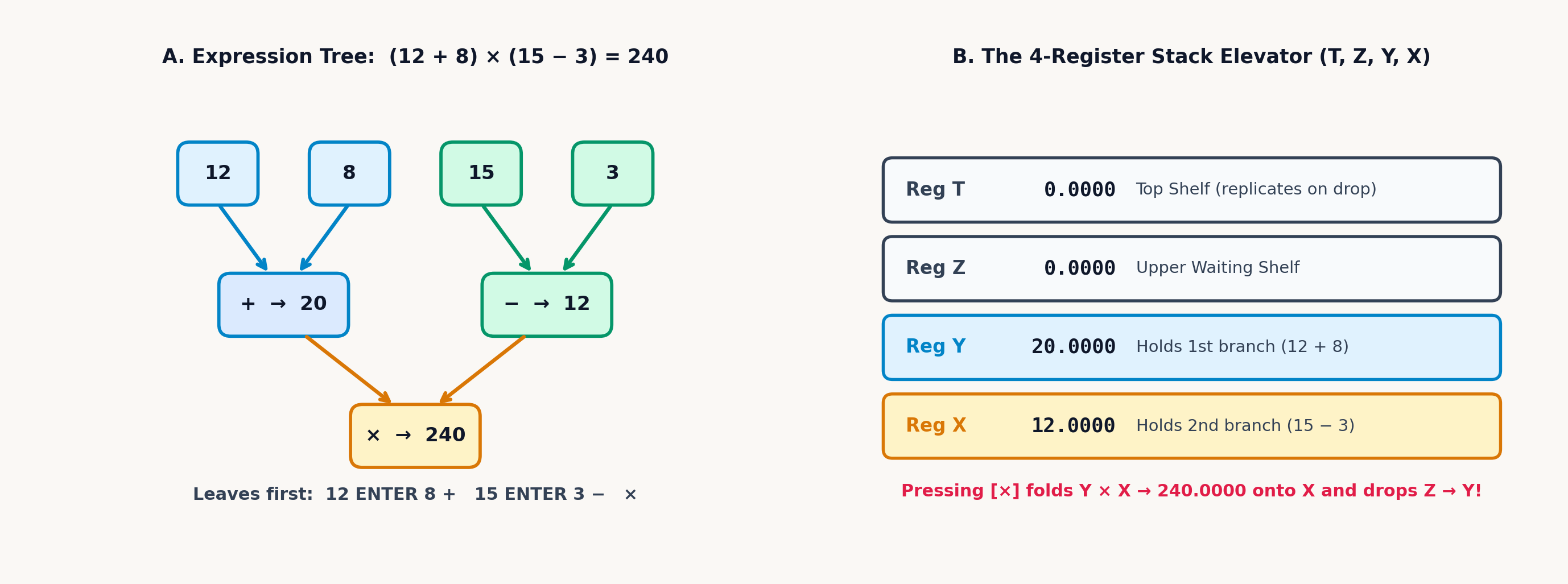
Across the four vertical registers, every stack lift shifts subtotals upward toward Register \(T\), and every dyadic (two-operand) operation drops waiting subtotals downward toward Register \(X\):
| Stack Register | Movement on Lift (ENTER / Armed Digit) |
Movement on Dyadic Drop (+, -, ×, ÷, yˣ, x∥y) |
|---|---|---|
| Register T (Line 4) | Receives \(Z_{\text{old}}\) (\(T_{\text{old}}\) shifts out in 4-LVL) |
Copies \(T_{\text{old}}\) downward into \(Z\) while remaining in \(T\) |
| Register Z (Line 3) | Receives \(Y_{\text{old}}\) as a second branch starts | Drops \(Z_{\text{old}}\) down into \(Y\), ready to combine with \(X\) |
| Register Y (Line 2) | Receives \(X_{\text{old}}\) (ENTER disables lift; armed digit lifts) |
Consumed with \(X_{\text{old}}\); receives \(Z_{\text{old}}\) from Register \(Z\) |
| Register X (Line 1) | Holds copy on ENTER (overwritten by next digit) |
Receives new result \(f(Y_{\text{old}}, X_{\text{old}})\) and arms stack lift |
To govern how newly keyed numbers enter Register \(X\), the stack-lift state machine alternates between two states: Neutral (Stack Lift = FALSE) after ENTER or CLx, and Armed (Stack Lift = TRUE) after an operator or function. Whereas pressing ENTER after the first number of a pair copies that number into Register \(Y\) and disables stack lift so the second number overwrites Register \(X\) in place, every arithmetic operator or mathematical function produces a completed result in Register \(X\) and arms stack lift, so the first digit of the next number lifts that result into Register \(Y\) without a second ENTER. Because constants (\(\pi\)), recalled variables, and function outputs are already completed values, ENTER is needed only to separate two numbers typed consecutively on the numeric keypad (or to duplicate Register \(X\) before squaring or constant-filling); pressing ENTER after a constant, a recalled variable, or a unary function duplicates that value into Register \(Z\).
This inside-out discipline clarifies a recurring problem in algebra and operations engineering. In a semiconductor fabrication plant, an engineer schedules an urgent wafer lot across two independent photolithography cells feeding the same etching bay: Cell A, the primary high-speed stepper, completes the entire lot alone in \(60\text{ minutes}\), and Cell B, an auxiliary stepper, completes the same lot alone in \(180\text{ minutes}\). When both Cell A and Cell B run together, the two cells work in parallel to complete the lot.
A common algebraic mistake is to average the two elapsed times (\((60 + 180)/2 = 120\text{ minutes}\)) or add them (\(240\text{ minutes}\)). A physical bounds check rules out both answers (Strogatz, 2012; Ellenberg, 2014): if Cell A alone finishes the lot in \(60\text{ minutes}\), activating a second cell alongside it cannot make the job take longer than \(60\text{ minutes}\). Two cells operating together must finish in less time than the faster single cell (\(T_{\text{together}} < 60\text{ minutes}\)), because parallel processes add their throughput rates, not their elapsed times.
The completion rate per minute resolves the relationship. Because Cell A completes \(1\text{ lot}\) in \(60\text{ minutes}\), in a single minute it completes a fraction of the lot equal to its reciprocal, \(R_A = \frac{1}{60} \approx 0.017\text{ lots per minute}\). Because Cell B completes \(1\text{ lot}\) in \(180\text{ minutes}\), in a single minute it contributes \(R_B = \frac{1}{180} \approx 5.556 \times 10^{-3}\text{ lots per minute}\). With both cells running in parallel, the per-minute throughput rates sum to \(R_{\text{total}} = R_A + R_B = \frac{1}{60} + \frac{1}{180} = \frac{4}{180} \approx 0.022\text{ lots per minute}\), and the total time \(T_{\text{together}}\) required to complete \(1\text{ whole lot}\) is the reciprocal of that combined rate:
When the cleanroom brings two additional backup steppers online—Cell C, requiring \(90\text{ minutes}\) alone, and Cell D, also requiring \(90\text{ minutes}\) alone—those four cycle times (\(60, 180, 90,\) and \(90\)) obey the same harmonic reciprocal-sum law as electrical resistors wired in parallel or capacitors wired in series:
Because the parallel-harmonic operator (x∥y) is associative, all four completion times never need to occupy \(T, Z, Y,\) and \(X\) at once: combining the first two cells yields \(60 \parallel 180 = 45\text{ min}\), folding in Cell C reduces the time to \(45 \parallel 90 = 30\text{ min}\), and folding in Cell D reaches \(30 \parallel 90 = \mathbf{22.5\text{ min}}\) across Registers \(Y\) and \(X\) alone (just as two parallel transfer pumps rated at \(30\text{ min}\) and \(45\text{ min}\) combine in a single fold to \(30 \parallel 45 = \mathbf{18\text{ min}}\)).
2.1.3 Continued Fractions, Rational Approximations, and Nested Radicals
When reciprocals alternate with integer addition, they generate a classical structure in number theory known as a continued fraction. When designing a mechanical gear train to approximate an irrational orbital-period ratio \(x\)—as Christiaan Huygens did in 1680 for his brass planetarium—engineers peel off the leading integer part \(a_0 = \lfloor x \rfloor\), invert the remaining fractional tail, and extract a cascade of integer partial denominators \(a_1, a_2, a_3, \dots\):
When read from the top down, a continued fraction presents a deeply nested hierarchy in which each denominator \(a_k + 1/(\dots)\) contains another rational expression beneath it. Evaluating that same structure from the innermost denominator \(a_3\) upward eliminates every parenthesis: in the four-level continued fraction \(1 + \frac{1}{2 + \frac{1}{3 + 1/4}}\), the bottom tier \(3 + 1/4\) equals \(13/4 = 3.25\), its reciprocal \(4/13\) added to \(2\) forms \(30/13 \approx 2.308\), and inverting once more to \(13/30 \approx 0.433\) before adding \(1\) lands on \(\approx \mathbf{1.433}\) (\(43/30\)).
Continued fractions generate the best possible rational approximations to any irrational number for a given denominator size. Applying Euclidean reciprocal extraction to the 16-digit hardware constant \(\pi\) (\(\approx 3.142\)) exposes each convergent in succession. Subtracting the integer part \(3\) isolates the fractional remainder \(\approx 0.142\), whose reciprocal (\(1 / (\pi - 3)\)) is \(\approx 7.063\). Because \(7.063\) lies close to the integer \(7\), truncating the expansion at the first tier yields the classical first-order rational approximation:
Once \(7\) is subtracted from \(7.063\), the next remainder \(\approx 0.063\) has reciprocal \(\approx 15.997\), within \(0.003\) of the integer \(16\) (or \(15 + \frac{1}{1}\)). Truncating just before the large subsequent partial denominator (\(292\)) produces a four-tier continued fraction:
The rational approximation \(\frac{355}{113}\) is easily recalled by writing the first three odd integers twice (113355) and dividing the second triplet by the first (355 / 113). Discovered in the fifth century by Chinese mathematician Zu Chongzhi, \(\frac{355}{113}\) uses only three-digit integers yet matches \(\pi\) to six decimal places—an absolute error of \(2.67 \times 10^{-7}\) (less than nine parts in one hundred million)—and renders in mixed fraction format as 3 16/113 (\(\frac{355}{113}\)).
Because large partial denominators like \(292\) inside a continued fraction indicate that an irrational number can be closely approximated by rationals, the irrational number that is hardest to approximate with fractions is the one whose integer partial denominators \(a_0, a_1, a_2, \dots\) are as small as possible. Setting every partial denominator equal to \(1\) defines the golden ratio \(\varphi\):
Beneath the top fraction bar, the infinite tower \(1 + \frac{1}{1 + \frac{1}{1 + \dots}}\) is an exact, self-similar copy of the entire continued fraction \(\varphi\) itself. Replacing that infinite denominator with \(\varphi\) folds the unending staircase into the finite balance \(\varphi = 1 + 1/\varphi\); multiplying through by \(\varphi\) gives \(\varphi^2 - \varphi - 1 = 0\), whose positive root is \(\varphi = (1+\sqrt{5})/2 \approx \mathbf{1.618}\). In Diophantine approximation, \(\varphi\) is the most badly approximable of all real numbers, with rational convergents \(F_{n+1}/F_n\) (\(1/1, 2/1, 3/2, 5/3, 8/5, 13/8, \dots\)) approaching \(\varphi\) more slowly than those of any other irrational constant (\(|\varphi - p/q| > \frac{1}{\sqrt{5}q^2}\) asymptotically). In celestial mechanics and nonlinear dynamics, invariant phase-space tori whose winding-frequency ratio equals \(\varphi\) are the last to break up under gravitational perturbations because small-denominator harmonic resonances are maximally suppressed, and in golden-section unimodal search, spacing interior test evaluations by \(1/\varphi = \varphi - 1 \approx 0.618\) guarantees that each function evaluation reuses one interior point from the previous bracket while shrinking the search interval by a constant factor of \(\approx 0.618\) at every step.
Where Euclid's algorithm nests reciprocals, François Viète's 1593 infinite product for \(\pi\) nests square roots to compare the area of a circle to an infinite sequence of inscribed regular polygons. Inscribing a square (\(4\) sides) inside a unit circle of radius \(r = 1\) and repeatedly doubling the number of polygon sides to an octagon (\(8\) sides), a \(16\)-gon, a \(32\)-gon, and a \(64\)-gon bisects the central wedge angle \(\theta\) at each stage, scaling the polygon area at each step by the cosine of the half-angle \(\cos(\theta/2)\):
Writing the half-angle cosine as \(2\cos(\theta/2) = \sqrt{2 + 2\cos\theta}\) turns repeated angle bisection into an iterative recurrence: each new doubled cosine is formed simply by adding \(2\) to the previous value and extracting the square root. Starting from an initial right angle \(\theta_1 = 90^\circ\) (\(\pi/2\text{ radians}\), where \(\cos 90^\circ = 0\)), successive bisections build a tower of nested radicals: the first bisection at \(45^\circ\) (an octagon) gives \(2\cos(45^\circ) = \sqrt{2}\); the second bisection at \(22.5^\circ\) (a \(16\)-gon) gives \(2\cos(22.5^\circ) = \sqrt{2 + \sqrt{2}} \approx 1.848\); the third bisection at \(11.25^\circ\) (a \(32\)-gon) gives \(2\cos(11.25^\circ) = \sqrt{2 + \sqrt{2 + \sqrt{2}}} \approx 1.962\); and the fourth bisection at \(5.625^\circ\) (a \(64\)-gon) reaches \(2\cos(5.625^\circ) = \sqrt{2 + \sqrt{2 + \sqrt{2 + \sqrt{2}}}} \approx 1.99\), approximating \(\pi \approx 3.121\) after three tiers and \(\approx \mathbf{3.137}\) after four tiers. Like continued fractions, Viète's nested radical product requires deep parenthesis nesting when written from the outside in, yet simplifies naturally from the innermost radicand outward (Cochran, 1972).
2.2 The Grammar of Stack Lift and Constant Memory
An RPN operational stack is a deterministic finite-state automaton. Inheriting the classical four-register state-transition architecture established on the HP-35, HP-15C, and HP-32SII (Cochran, 1972; HP, 1982; HP, 1991), a single seven-element state vector \(\mathcal{S}\) specifies the instrument's response to every keystroke on the faceplate:
Alongside the four visible operational registers \(X, Y, Z, T\) (ordered from Line 1 up to Line 4) and the LASTX shadow register \(L\) (which preserves the prior value of Register \(X\) before each numeric operation), two boolean flags govern how incoming digits interact with the active line: Stack Lift Enabled (\(\mathcal{L}_{\text{lift}} \in \{\text{TRUE}, \text{FALSE}\}\)) determines whether a newly started number pushes \(X\) up into \(Y\), while Digit Entry Active (\(\mathcal{B}_{\text{entry}} \in \{\text{TRUE}, \text{FALSE}\}\)) tracks whether subsequent digit keys append to an open string in Register \(X\) or start a fresh entry.
With respect to stack lift, every key on the faceplate belongs to one of four transition classes:
| Transition Class | Representative Keys | Effect on Registers \((T, Z, Y, X)\) | Post-Op Stack Lift |
|---|---|---|---|
| 1. Neutralizing Keys | ENTER, <- / C (CLx), Σ+, Σ- |
ENTER copies \(X \to Y\) (lifting \(Y \to Z \to T\)); <- / C zeroes \(X\) in place |
Neutral (FALSE): Next number typed overwrites \(X\) in place |
| 2. Arming Keys | 1/x, √x, LN, SIN, x⇄y, R↓, RCL, LASTX, π |
Transforms \(X\) in place (saving prior \(X\) in LASTX) or recalls/permutes registers |
Armed (TRUE): Next digit typed lifts \(X \to Y \to Z \to T\) |
| 3. Digit Entry | 0–9, ., E |
If Armed, lifts \(X \to Y \to Z \to T\) before starting new entry; if Neutral, overwrites \(X\) in place | Armed (TRUE) once the entry completes |
| 4. Dyadic Drop | +, -, ×, ÷, yˣ, x∥y |
Combines \(Y\) and \(X\) into \(X\), drops \(Z \to Y\), and replicates \(T \to Z\) (in 4-LVL mode) |
Armed (TRUE): Result lifts on next entry |
2.2.1 How Register T Acts as an Automatic Constant Supply
At the top of the four-register stack, Register \(T\) (Line 4) implements a retention rule that governs what happens when two operands in Registers \(Y\) and \(X\) combine and the upper registers drop by one level. If Register \(T\) cleared to zero every time the stack dropped, three consecutive dyadic operations would leave the upper registers empty. Instead, in 4-LVL mode, Register \(T\) exhibits \(T\)-Register Duplication:
Whenever a dyadic operation drops the stack, Register \(T\) copies its value downward into Register \(Z\) while retaining its own value in \(T\). That single hardware rule turns the top register into a constant supply: in compound growth, filling the upper stack with a growth factor \((1 + r) = 1.065\) and starting from an initial principal \(P_0 = \$2,500\) advances the balance period by period (\(P_1 = \$2,662.5 \to P_2 \approx \$2,835.563 \to P_3 \approx \$3,019.874 \to P_4 \approx \$3,216.166 \to P_5 \approx \mathbf{\$3,425.217}\)), while a machinist scaling a table of inch dimensions by \(k = 25.4\text{ mm/in}\) (\(0.375\text{ in} \to 9.525\text{ mm}\) through \(5.5\text{ in} \to \mathbf{139.7\text{ mm}}\)) draws \(25.4\) repeatedly from Register \(T\).
To reorder operands already on the stack without re-entry, the two-register swap exchanges Registers \(Y\) and \(X\) (\(X \leftrightarrow Y\)), while the four-register cyclic permutations (Roll Down and Roll Up) rotate all four registers in a closed ring (\(X \leftarrow Y \leftarrow Z \leftarrow T \leftarrow X\), so four thermocouple readings \(21.5^\circ\text{C}, 24.8^\circ\text{C}, 28.2^\circ\text{C}, 31^\circ\text{C}\) can be inspected in turn and returned to their original positions):
Two-register exchange and in-place inversion also handle non-commutative division (\(Y \div X\)) and subtraction (\(Y - X\)) whenever a formula's denominator or subtracted term is more complicated than its numerator or leading term, as in resonant frequency \(f_0 = \frac{1}{2\pi\sqrt{LC}}\), impedance current \(I = \frac{V_s}{\sqrt{R^2 + X^2}}\), or Carnot thermal efficiency \(\eta = 1 - \frac{T_C}{T_H}\). Evaluating the multi-step denominator \(D\) or subtrahend \(S\) first inside Register \(X\) keeps the upper stack untouched and leaves two equivalent paths to complete the calculation without re-entry: either invert or negate Register \(X\) in place (\(D^{-1}\) or \(-S\)) and multiply or add the numerator \(N\) or minuend \(M\) (\(D^{-1} \times N\) or \(-S + M\)), or enter \(N\) or \(M\) second (which lifts \(D\) or \(S\) into Register \(Y\)) and exchange Registers \(X \leftrightarrow Y\) so the operands sit in standard \((Y = N,\; X = D)\) or \((Y = M,\; X = S)\) order before dividing or subtracting.
Alongside the four visible registers, every operation that modifies Register \(X\) saves its prior occupant in the last-argument shadow register (LASTX). In an unnormalized sinc ratio \(\operatorname{sinc} x = \frac{\sin x}{x}\), evaluating \(\sin(0.42) \approx 0.408\) in radians preserves the pre-sine angle \(0.42\) in LASTX, so recalling LASTX and dividing yields \(\frac{\sin(0.42)}{0.42} \approx \mathbf{0.971}\). In Fraunhofer single-slit diffraction, where monochromatic light of wavelength \(\lambda\) passes through an aperture of slit width \(a\) and spreads out at diffraction angle \(\theta\), the optical path difference across the slit defines the half-aperture phase parameter \(\beta = \frac{\pi a}{\lambda}\sin\theta\); for \(\beta = 0.085\text{ rad}\), the same two-step sequence gives the normalized far-field diffraction amplitude \(\frac{\sin\beta}{\beta} = \frac{\sin(0.085)}{0.085} \approx \mathbf{0.999}\) without re-entering \(\beta\).
On the display, twelve-digit base-10 guard rounding suppresses binary representation residuals (rendering \(0.1 + 0.2\) as 0.3 while retaining the 53-bit binary64 significand in memory); rounding to display precision (RND) replaces Register \(X\)'s internal 53-bit significand with its currently displayed value, quantizing a currency or tolerance figure to two decimal places under FIX 2 so unshown fractional digits do not accumulate across downstream sums. Depending on how many independent subtotals an expression requires, four selectable stack-depth architectures generalize the operational stack:
| Mode ID | Architecture Name | Accessible Registers | Stack Drop Behavior | Recommended Application Zone |
|---|---|---|---|---|
| 2-LVL | 2-Level B-Register Stack | \(X, T\) (\(Y\)-position) | 2-register accumulator; \(T\) retains its value in \(Y\) on drop while \(X\) holds the result | Simple adding-machine tallies and two-operand arithmetic |
| 4-LVL | Classic 4-Level Stack (Default) | \(X, Y, Z, T\) | Top-of-stack \(T\)-duplication on drop; classic 4-register behavior | Everyday engineering, Horner recurrences, constant scaling |
| 8-LVL | Extended 8-Level Stack | \(R_1 \dots R_8\) (displayed as \(X, Y, Z, 4, 5, 6, 7, T\)) | Holds up to 8 real operands (or 4 complex pairs) before \(T\) (\(R_8\)) replication | Multi-branch complex phasor algebra, 5-to-8-register expressions |
| INF | Unbounded Infinite Stack | Dynamic heap allocation (up to 999 levels) | True LIFO stack; dyadic drop never duplicates; pulls from history | 5+ branch parallel networks, long product-sum series |
2.2.2 Named Variables and Indirect Memory Addressing
When all four stack registers (\(T, Z, Y, X\)) hold live subtotals and a calculation requires a constant stored in one of the 26 lettered variables A–Z, a standard recall lifts the stack by one level and pushes the occupant of Register \(T\) over the cliff in 4-LVL mode. Three non-destructive mechanisms resolve this full-stack bottleneck while preserving Registers \(Y, Z,\) and \(T\): first, non-destructive variable inspection displays the value of any stored variable on the status line (or in a read-only register catalog) without lifting the stack; second, two-way in-place storage arithmetic updates Register \(X\) in place as \(X \leftarrow X \text{ op } A\) (Recall Arithmetic—for example, scaling \(X = 40\) by \(A = 2.5\) to \(\mathbf{100}\) while \(10, 20, 30\) remain untouched in the upper stack) or updates Variable A in place as \(A \leftarrow A \text{ op } X\) (Store Arithmetic); and third, in-place variable exchange swaps Register \(X\) with any named variable (\(X \leftrightarrow A\)) to park an intermediate subtotal and bring a stored parameter onto the active line.
To step across memory without hard-wiring a fixed variable name (A, B, C), an index register (i) holds an integer slot number \(k\) so that indirect addressing ((i)) can dynamically reference whichever memory slot resides at address \(k\) across a unified 89-slot memory map:
| Pointer Range \(k \in \{1, \dots, 89\}\) | Target Memory Bank | Addressed Register / Content | Access Permissions |
|---|---|---|---|
1 … 26 |
Lettered Variables (A–Z) |
1 = A, 2 = B, 3 = C, …, 26 = Z |
Full Read / Write (STO (i), RCL (i), x⇄? (i)) |
27 |
Index Register (i) |
27 = Index register i itself |
Full Read / Write |
28 … 33 |
Statistical Accumulators | 28 = \(\Sigma n\), 29 = \(\Sigma x\), 30 = \(\Sigma y\), 31 = \(\Sigma x^2\), 32 = \(\Sigma y^2\), 33 = \(\Sigma xy\) |
Read / Write via (i) |
34 … 39 |
POLY Solver Roots |
Slots 34–39 (Real & imaginary parts of roots \(r_1, r_2, r_3\)) |
Read via RCL (i) |
40 … 89 |
Statistical Data Points | DATA0 (40) through DATA49 (89) |
Read via RCL (i) |
| \(k < 1\) or \(k > 89\) | Out of Bounds | Displays INVALID DATA |
N/A (Halts without stack corruption) |
Where a single-line parenthesized expression hides intermediate quantities until the final result appears, evaluating an equation across the four visible registers exposes every physical subtotal—thermal voltage, cross-sectional area, characteristic impedance, or dynamic pressure—live on the glass as it forms, making a tenfold unit or sign error visible before it propagates downstream.
2.3 Five Patterns for Evaluating Any Formula
Five stack-control keys and two memory-addressing mechanisms on the physical SC-32 keypad govern how numbers move across Registers \(T, Z, Y,\) and \(X\):
* Stack Entry, Non-Commutative Alignment & Rearrangement ([ENTER], [x⇄y], [1/x], [+/-], [R↓], [↱] [R↑], [<-]): Pressing [ENTER] separates two consecutively typed numbers by copying Register \(X\) into Register \(Y\) and disabling stack lift (constants like [↱] [π], recalled variables, and function outputs are already self-delimited and arm stack lift). When a multi-step denominator \(D\) or subtrahend \(S\) is evaluated first in Register \(X\), pressing [1/x] or [+/-] before multiplying or adding the numerator or minuend—or entering the numerator/minuend second and pressing [x⇄y] (\(X \leftrightarrow Y\)) before [÷] or [-]—completes the ratio or difference without re-entry; [R↓] and [↱] [R↑] (right-shifted on [R↓]) rotate all four registers cyclically; and [<-] clears a mistyped entry in Register \(X\) without disturbing \(Y, Z,\) or \(T\).
* Harmonic Operator ([x∥y]), Shadow Register ([↰] [LASTX]), & Display Rounding ([↰] [RND]): Pressing [x∥y] evaluates the parallel product-over-sum \(\frac{Y \cdot X}{Y + X}\), [↰] [LASTX] (left-shifted on [ENTER]) recalls the pre-operation value of Register \(X\) saved before the most recent numeric operation, and [↰] [RND] (left-shifted on [RCL]) rounds Register \(X\)'s internal 53-bit value to match the active [↰] [DISP] setting (FIX, SCI, or ENG).
* Stack Depth ([↱] [FLAGS]), Non-Destructive Inspection ([↱] [VIEW], [↰] [REGS], MEM), & Storage Addressing (i and (i)): Pressing [↱] [FLAGS] (right-shifted on [×]) and tapping STACK selects \(\mathtt{[2\text{-}LVL]} \;\; \mathtt{[4\text{-}LVL]} \;\; \mathtt{[8\text{-}LVL]} \;\; \mathtt{[INF]} \;\; \mathtt{[VIEW]}\) (4-LVL default). To inspect memory without lifting the stack, [↱] [VIEW] (right-shifted on [0]) prompts for A–Z and displays "A = ..." on the status line without altering \(T, Z, Y,\) or \(X\), while [↰] [REGS] (left-shifted on [0]) and MEM (left-shifted on [x⇄y]) browse the stack, variables, statistical registers, and equations read-only. Pressing [STO] or [RCL] activates the A–Z Alpha layer (. addresses i; [x∥y] addresses (i)). Inserting an operator ([STO] [+] A or [RCL] [×] A, plus [-] and [÷]) performs in-place storage or recall arithmetic without stack lift, right-shifted x⇄? on [x⇄y] swaps Register \(X\) with a variable in place, and [↱] [EQN] and [XEQ] store and execute symbolic postfix equations with automatic variable prompts.
Every multi-stage formula in algebra and engineering reduces to one of five patterns on these keys: evaluating a two-branch rational quotient across three registers, generating continued fractions and nested radicals from the bottom up, reusing a shared divisor across multiple branches with LASTX, evaluating polynomials without exponents via Horner's method, and stepping through memory slots with (i).
2.3.1 Evaluating Two-Branch Rational Quotients Across Three Registers
Whenever a formula adds or subtracts two products in the numerator and divides by a two-term denominator, only three registers (\(X, Y, Z\)) are required. In the calorimetric stream balance \(\frac{(60 \times 2.5) + (35 \times 4)}{18 - 5.5}\), the first numerator product (\(150\)) lifts into Register \(Z\) while the second product (\(35 \times 4 = 140\)) forms across Registers \(Y\) and \(X\); addition collapses both branches into the completed numerator (\(290\)) in Register \(X\); keying 18 ENTER 5.5 shifts \(290\) into Register \(Z\) before subtraction forms the denominator (\(12.5\)) in Register \(X\) and drops \(290\) into Register \(Y\); and division completes the quotient:
| Keystroke | Register T | Register Z | Register Y | Register X | What Happens on the Stack |
|---|---|---|---|---|---|
60 [ENTER] 2.5 [×] |
\(0\) | \(0\) | \(0\) | \(150\) | First numerator product \(60 \times 2.5 = 150\); stack lift armed |
35 [ENTER] 4 |
\(0\) | \(150\) | \(35\) | \(4\) | Second branch lifts \(150\) into \(Z\) while \(35\) and \(4\) occupy \(Y\) and \(X\) |
[×] [+] |
\(0\) | \(0\) | \(0\) | \(290\) | Product \(140\) drops \(150\) to \(Y\) and sums to completed numerator \(290\) |
18 [ENTER] 5.5 [-] |
\(0\) | \(0\) | \(290\) | \(12.5\) | Denominator \(18 - 5.5 = 12.5\) in \(X\); numerator \(290\) drops from \(Z\) to \(Y\) |
[÷] |
\(0\) | \(0\) | \(0\) | \(23.2\) | Final quotient \(290 \div 12.5 = 23.2\) |
This same three-register sequence governs two-branch balances across heat transfer, bridge instrumentation, and spacecraft radiative transport. In a two-pass heat exchanger, summing two heat-flux streams (\(18.5 \times 4.2\) and \(7.1 \times 9.6\)) and dividing by the wall temperature difference (\(14.3 - 5.8\)) yields the overall heat-transfer conductance \(U\). In a four-resistor Wheatstone bridge powered by excitation voltage \(V_{\text{exc}}\), two parallel voltage-divider legs (\(R_1, R_3\) on the left and \(R_2, R_4\) on the right) split the supply rail, and a voltmeter wired between their midpoints measures the differential output voltage \(V_{\text{diff}}\). And in vacuum radiative heat transfer between two parallel plates at absolute temperatures \(T_1\) and \(T_2\) with infrared surface emissivities \(\varepsilon_1\) and \(\varepsilon_2\) (scaled by the Stefan–Boltzmann constant \(\sigma \approx 5.67 \times 10^{-8}\text{ W/(m}^2\cdot\text{K}^4)\)), the net radiative heat flux \(q\) (watts per square meter) balances blackbody emission against multiple surface reflections:
Although these three equations come from different laboratories, each pits a combined driving potential against a net opposing resistance or reference branch. Overall conductance \(U\) divides the combined thermal power of both fluid passes by the wall temperature span. Across the Wheatstone bridge, the two midpoint divider ratios \(\frac{R_3}{R_1+R_3}\) and \(\frac{R_4}{R_2+R_4}\) cancel to zero whenever all four arms match, isolating any slight resistance shift in an active strain gauge \(R_3\) as a clean differential signal scaled by \(V_{\text{exc}}\). Between the vacuum radiation plates, the ideal fourth-power blackbody flux \(\sigma(T_1^4 - T_2^4)\) is throttled by the combined gray-body surface reflection resistance \(\frac{1}{\varepsilon_1} + \frac{1}{\varepsilon_2} - 1\), which equals \(1\) for perfect blackbodies (\(\varepsilon_1 = \varepsilon_2 = 1\)) and grows larger as polished, low-emissivity foil reflects infrared photons back and forth.
In the heat-exchanger balance \(U\), the first thermal product (\(77.7\)) waits in Register \(Z\) while the second (\(68.16\)) forms in Registers \(Y\) and \(X\), and their summed numerator (\(145.86\)) waits in Register \(Z\) while the temperature difference (\(8.5\)) forms, dividing to \(\approx \mathbf{17.16\text{ W/(m}^2\cdot\text{K)}}\). In a Wheatstone bridge (\(R_3 = 351.4\,\Omega\) active metallic strain gauge against three \(350\,\Omega\) reference arms under \(V_{\text{exc}} = 10\text{ V}\)), subtracting the balanced reference ratio \(0.5\) from the active divider ratio \(351.4/(350 + 351.4) \approx 0.501\) and scaling by \(10\text{ V}\) isolates a \(\approx \mathbf{9.98\text{ mV}}\) strain signal. Across a two-panel spacecraft radiation shield (\(T_1 = 800\text{ K}, \varepsilon_1 = 0.85\) and \(T_2 = 500\text{ K}, \varepsilon_2 = 0.7\)), the blackbody numerator \(\sigma(T_1^4 - T_2^4) \approx 19,681.854\text{ W/m}^2\) waits in Register \(Z\) while the emissivity denominator \(1/\varepsilon_1 + 1/\varepsilon_2 - 1 \approx 1.605\) combines in Registers \(Y\) and \(X\), dividing to a net radiative flux of \(q \approx \mathbf{12,262.517\text{ W/m}^2}\).
2.3.2 Climbing Continued Fractions and Nested Radicals from the Bottom Up
In vertically nested expressions like the golden ratio continued fraction \(\varphi = 1 + \frac{1}{1 + \frac{1}{1 + \dots}}\), bottom-up evaluation reduces each tier in place. Flooding all four stack registers with \(1\) uses Register \(T\)'s constant replication to supply an endless stream of \(1\)'s into Register \(Y\), so repeatedly taking the reciprocal in place and adding generates the sequence of Fibonacci rational convergents step by step (\(2/1 = 2 \to 3/2 = 1.5 \to 5/3 \approx 1.667 \to 8/5 = 1.6 \to 13/8 = 1.625 \to \dots \to \varphi \approx \mathbf{1.618}\)).
When evaluation begins at the deepest radical or dimensionless ratio, spacecraft orbital transfer and AC filter calculations unfold without parentheses. Consider a spacecraft orbiting in Earth's gravity well, governed by Earth's standard gravitational parameter \(\mu = GM_\oplus\): to lift the craft from a circular parking orbit of inner radius \(r_1\) up to an outer target radius \(r_2\) along a minimum-energy Hohmann transfer ellipse of semi-major axis \(a = (r_1 + r_2)/2\), the engine must fire at perigee with velocity impulse \(\Delta v_1\), raising the spacecraft's orbital speed \(v\) at radial distance \(r\) according to the vis-viva energy integral. Similarly, when an alternating audio signal of frequency \(f\) passes through a series high-pass filter built from resistance \(R\) and capacitance \(C\), the dimensionless frequency ratio \(X = 2\pi f R C\) (comparing the signal frequency \(f\) to the RC corner frequency) sets the voltage transfer magnitude \(|H|\):
Firing a Hohmann perigee burn scales the initial circular parking speed \(\sqrt{\mu/r_1}\) by the dimensionless boost factor \(\sqrt{\frac{2r_2}{r_1+r_2}} - 1\) required to raise apogee from \(r_1\) to \(r_2\). Along the resulting transfer ellipse, the vis-viva balance trades local gravitational potential (\(2/r\)) against the orbit's fixed binding energy (\(1/a\)), slowing the spacecraft as radial distance \(r\) climbs toward apogee. In the high-pass audio filter, the capacitor blocks direct current as \(X \to 0\) (\(|H| \to 0\)) and becomes a transparent short circuit at high frequencies (\(X \gg 1\), where \(\sqrt{1+X^2} \approx X\) and \(|H| \to 1\)).
For a Hohmann transfer between a low Earth parking orbit (\(r_1 = 6,678\text{ km}\)) and geostationary altitude (\(r_2 = 42,164\text{ km}\), with \(\mu = 398,600\text{ km}^3/\text{s}^2\)), computing the inner radius ratio \(\frac{2r_2}{r_1+r_2} \approx 1.727\) first, taking its square root (\(\approx 1.314\)), and subtracting \(1\) isolates the dimensionless impulse factor \(\approx 0.314\) before scaling by the circular parking speed \(\sqrt{\mu/r_1} \approx 7.726\text{ km/s}\) to obtain the perigee burn \(\Delta v_1 \approx \mathbf{2.426\text{ km/s}}\); along that transfer ellipse of semi-major axis \(a = 24,421\text{ km}\), the vis-viva integral gives the total perigee speed \(v_p \approx \mathbf{10.152\text{ km/s}}\). In a first-order high-pass RC audio filter (\(R = 10,000\,\Omega\), \(C = 15 \times 10^{-9}\text{ F}\) at \(f = 2,500\text{ Hz}\)), forming the normalized frequency ratio \(X = 2\pi f R C \approx 2.356\) once, duplicating it into Register \(Y\), and transforming Register \(X\) into \(\sqrt{1 + X^2} \approx 2.56\) before dividing yields the voltage gain \(|H| \approx \mathbf{0.921}\) across Registers \(Y\) and \(X\).
2.3.3 Reusing a Shared Divisor or Argument with LASTX
When three resistors \(R_{12}, R_{23}, R_{31}\) are wired in a closed triangular delta (\(\Delta\)) between terminal nodes \(1, 2,\) and \(3\) inside a bridge or a three-phase industrial motor starter, circuit analysis often requires replacing the triangle with an equivalent three-branch star (\(\text{Y}\)) of wye resistances \(R_a, R_b, R_c\) radiating from a central neutral point. The \(\Delta \to \text{Y}\) impedance transformation equates the terminal-to-terminal resistances of both networks by dividing each adjacent pair product by the shared delta perimeter sum \(S = R_{12} + R_{23} + R_{31}\):
Each equivalent star resistor \(R_a, R_b, R_c\) pairs the two delta arms that meet at its terminal corner (\(R_{12}R_{31}\) at node \(1\), \(R_{12}R_{23}\) at node \(2\), and \(R_{23}R_{31}\) at node \(3\)) and divides their product by the common loop resistance \(S = R_{12} + R_{23} + R_{31}\) around the entire triangle. For \(R_{12} = 30\,\Omega,\; R_{23} = 45\,\Omega,\; R_{31} = 60\,\Omega\), that shared loop sum is \(S = 30 + 45 + 60 = 135\,\Omega\). Dividing the first pair product \(R_{12}R_{31} = 1,800\,\Omega^2\) by \(135\,\Omega\) yields the first star branch \(R_a = 1,800 / 135 \approx \mathbf{13.333\,\Omega}\) and latches the divisor \(135\,\Omega\) in LASTX. Recalling \(135\,\Omega\) from LASTX before forming each remaining pair product (\(R_{12}R_{23} = 1,350\,\Omega^2\) and \(R_{23}R_{31} = 2,700\,\Omega^2\)) and swapping Registers \(Y\) and \(X\) to divide places all three wye resistances (\(\approx 13.333\,\Omega\), \(10\,\Omega\), and \(20\,\Omega\)) on the stack without re-entering \(S\).
The LASTX shadow register also eliminates duplicate entry in any single-variable difference like \(f(x) = e^x - \ln(x)\) at \(x = 2.5\): evaluating \(e^{2.5} \approx 12.182\) saves \(2.5\) in LASTX, so recalling LASTX to take \(\ln(2.5) \approx 0.916\) and subtracting yields \(\approx \mathbf{11.266}\). And if a mistyped cross-sectional area of \(19\text{ mm}^2\) is keyed after computing a tensile load of \(36 \times 12.5 = 450\text{ N}\), clearing Register \(X\) zeroes the active line and disables stack lift so the corrected area \(18\text{ mm}^2\) overwrites the zero in place (\(450 \div 18 = \mathbf{25\text{ MPa}}\)).
2.3.4 Nested Polynomials and Horner's Evaluation Scheme
When a cubic polynomial \(P(x) = 2x^3 - 5x^2 + 3x + 7\) is factored into nested linear binomials \(((2x - 5)x + 3)x + 7\)—Horner's evaluation scheme—every power operation disappears. Flooding all four registers with the evaluation point \(x = 3.5\) lets Register \(T\)'s constant replication supply \(x = 3.5\) at each multiplication stage, evaluating the cubic to \(\mathbf{42}\) in three linear steps:
| Keystroke | Register T | Register Z | Register Y | Register X | What Happens on the Stack |
|---|---|---|---|---|---|
3.5 [ENTER] [ENTER] [ENTER] |
\(3.5\) | \(3.5\) | \(3.5\) | \(3.5\) | Flood all 4 registers with evaluation point \(x = 3.5\) |
2 [×] 5 [-] |
\(3.5\) | \(3.5\) | \(3.5\) | \(2\) | Innermost Horner binomial \(2x - 5 = 2(3.5) - 5 = 2\) |
[×] 3 [+] |
\(3.5\) | \(3.5\) | \(3.5\) | \(10\) | Second Horner stage \((2x - 5)x + 3 = 2(3.5) + 3 = 10\) |
[×] 7 [+] |
\(3.5\) | \(3.5\) | \(3.5\) | \(42\) | Outer Horner stage \(((2x - 5)x + 3)x + 7 = 10(3.5) + 7 = 42\) |
Pushing a fifth number (\(50\)) onto \(10, 20, 30, 40\) and summing illustrates why 4-LVL mode suits Horner recurrences while 8-LVL and INF modes serve deep multi-branch sums: in 4-LVL mode, pushing \(50\) shifts \(10\) off the top of Register \(T\), and as \(40 + 50 = 90\) drops the stack, Register \(T\) replicates \(20\) downward so three additions yield \(20 + 30 + 90 = \mathbf{140}\); in 8-LVL or INF mode, \(10\) is preserved at level 5 and drops back into Register \(T\) as the lower pairs collapse, so summing all five terms yields \(\mathbf{150}\).
When a calibration routine or data-logging loop must step through sequential variables without hard-wiring A, B, C into each command, the index register i and indirect pointer (i) turn the 89-slot memory map into an addressable array: storing calibration offset \(120\) in Variable A (slot \(k = 1\)) and \(250\) in Variable B (slot \(k = 2\)), loading \(k = 1\) into i lets an indirect recall fetch slot \(1\) (\(120\)), while adding \(1\) to pointer i via storage arithmetic (1 STO+ i) advances i to slot \(2\) so an indirect store-addition of \(35\) (35 STO+ (i)) updates Variable B to \(250 + 35 = \mathbf{285}\).
2.3.5 Try It on the Stack
- Three-Resistor Parallel Shunt Network: Fold three current-sense shunt resistors of \(R_1 = 30\,\Omega\), \(R_2 = 45\,\Omega\), and \(R_3 = 90\,\Omega\) in parallel using the harmonic parallel operator. (Verified Register \(X\) result: \(R_{\text{eq}} = \mathbf{15\,\Omega}\).)
- Delta-to-Wye (\(\Delta \to \text{Y}\)) Network Conversion: For a three-terminal bridge with delta resistors \(R_{ab} = 20\,\Omega\), \(R_{bc} = 30\,\Omega\), and \(R_{ca} = 50\,\Omega\) (perimeter sum \(S = 100\,\Omega\)), evaluate the three equivalent wye branch resistances \(R_a = R_{ab}R_{ca}/S\), \(R_b = R_{ab}R_{bc}/S\), and \(R_c = R_{bc}R_{ca}/S\) using
LASTXto restore the shared divisor \(S = 100\,\Omega\) for each remaining pair product. (Verified Register \(X\) results: \(R_a = \mathbf{10\,\Omega}\), \(R_b = \mathbf{6\,\Omega}\), and \(R_c = \mathbf{15\,\Omega}\).) - Golden Ratio Continued Fraction via \(T\)-Replication: Fill all four stack registers \((T, Z, Y, X)\) with \(1\) and alternate reciprocal and addition nine times to evaluate the tenth Fibonacci convergent \(F_{11}/F_{10} = 89/55\) of \(\varphi = 1 + \frac{1}{1 + \frac{1}{1 + \dots}}\). (Verified Register \(X\) result: \(\varphi_{10} \approx \mathbf{1.618}\).)